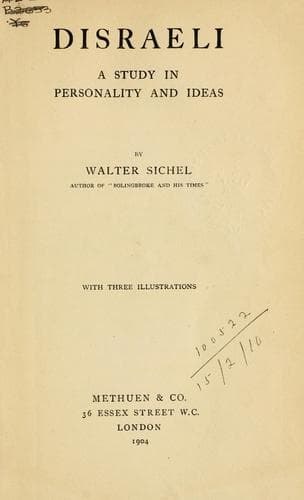
Disraeli: A Study in Personality and IdeasSichel, Walter
History
Disraeli: A Study in Personality and Ideas
Sichel, Walter
Disraeli, Benjamin, 1804-1881
the chorus of an emancipated people, and fancied, in order to take the
throne by storm, that nothing was wanting but to hoist the tricolour
and to cover their haughty brows with a red cap. This fatal blunder
clipped the wings of Whiggism; nor is it possible to conceive a party
that had effected so many revolutions and governed a great country for
so long a period more broken, sunk, and shattered, more desolate and
disheartened, than these same Whigs at the Peace of Paris.” But all
proved fruitless, until at last the vast body of the nation--the real
“people”--reasserted themselves, and, by emphasising Parliamentary
reform, compelled oligarchs, mistrustful of them at heart,[59] to “do
something.” What they “did” was to aggrandise the middle classes, on
whom they had always relied; and a new revolution was the consequence.
Throughout more than a century and a half, despite noble and national
intervals, they constantly betrayed themselves as a “faction who headed
a revolution with which they did not sympathise, in order to possess
themselves of a power which they cannot wield.” In 1718 they “sought
to govern the country by swamping the House of Commons.” In 1836 they
were for “swamping” the House of Lords. Their drift was continued
against the national institutions, the conjoined independence and
inter-dependence of which thwarted their inveteracy. Their plan in the
end became avowedly cosmopolitan; and when that occurred it became
doubly dangerous, for to “centralisation”--monopoly of power--was added
the no-principle of “_laissez-faire_,” the abandonment of leadership to
chaos.
The great national struggle against Napoleon practically obliterated
party distinctions in England, although there was still a remnant
of those who are, in Burke’s words: “... the most pernicious of all
factions, one in the interest and under the direction of foreign
powers.” A lull ensued. Both Toryism and Whiggism withered; the first
from sheer inanition of those popular principles which Canning in
vain sought to rekindle; the second from the sheer impossibility of
withstanding the name of Wellington and the memories of Waterloo.
Toryism turned against freedom and Liberalism against order. Public
spirit waned with the decay of party opposition. The great warriors
dwindled into petty place-men until
“Where are the Grenvilles? Turned as usual. Where
My friends the Whigs? Exactly where they were;”
until the “Marney” of _Sybil_ expired “in the full faith of dukeism and
babbling of strawberry leaves.”
Public-domain text, read in full here on John Shaqi.
Reviews
Reviews
No reviews yet
Be the first to share your thoughts on this work.
Elsewhere in the archive
Join the Discussion
Join the discussion
Sign in to leave a comment or review.
Sign InorCreate an account