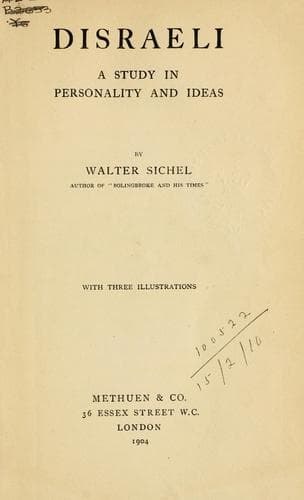
Disraeli: A Study in Personality and IdeasSichel, Walter
History
Disraeli: A Study in Personality and Ideas
Sichel, Walter
Disraeli, Benjamin, 1804-1881
history; to pry into the beginnings of some social anomalies which,
they found, were not so ancient as they had been led to believe, and
which had their origin in causes very different from what they had been
educated to credit; and insensibly it created and prepared a popular
intelligence to which one can appeal, no longer hopelessly, in an
attempt to dispel the mysteries with which for nearly three centuries
it has been the labour of party writers to involve a national history,
and without the dispersion of which no political position can be
understood and no social evil remedied.” This latter was an especial
province of Disraeli. Carlyle also, as a social regenerator appealing
to higher sanctions than the “useful,” was able to address the newly
awakened “popular intelligence.”
Here again Disraeli is in curious accord with Carlyle, the difference
between them being that Disraeli, a doer as well as a seer, discerned
in the traditional “orders” or “estates” of the realm real curatives
of a sick body politic. Both protested against a state based on
statistics and a progress that was arithmetical. Both were quick to
discriminate, under the surface of parties, between the influences
which made for cementing and those which made for dissolving the
nation. Both saw in the conservatism and liberalism of the ’thirties,
on the one side a pretence of protecting the forms they enfeebled,
on the other a pretext and a sop for the universal suffrage which
their professions logically implied. Disraeli perceived that such
a French democracy was alien to England, and meant eventually some
sort of unenlightened despotism, and the aggravation of a government
by favouritism and through interference. He therefore resolved to
reinspire the three “estates”--and if possible the Crown--with reality;
and thus, in extending franchise, to extend it as the privilege of
an order, earned by thrift, education, and intelligence, while he
sought to found it on a basis so stable that leadership might never
sink into being the sport of a fluid and fickle ignorance. Like
Carlyle, he rejoiced that “opinion is now supreme, and opinion speaks
in print; the representation of the Press is far more complete than
the representation of Parliament;” he hailed the spread of knowledge
among the mass so early as in the _Revolutionary Epick_. But, unlike
Carlyle, he did not deem this increasing power fatal to parliamentary
institutions; indeed, he regarded Parliament as a body privileged to
lead and leaven “opinion,” and one that should never abandon its proper
functions of initiative. Both Parliament and the Press in his eyes were
vents for that free discussion inseparable from political health, but
the one ought to form a school for statesmen, the other an arena for
critics. And Disraeli also held and enforced that parties should never
be particularist, but should rest on some national principle instead
of on incoherent prejudices. Parties should represent broad attitudes
Public-domain text, read in full here on John Shaqi.
Reviews
Reviews
No reviews yet
Be the first to share your thoughts on this work.
Elsewhere in the archive
Join the Discussion
Join the discussion
Sign in to leave a comment or review.
Sign InorCreate an account