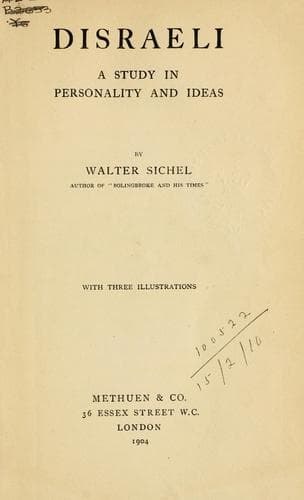
Disraeli: A Study in Personality and IdeasSichel, Walter
History
Disraeli: A Study in Personality and Ideas
Sichel, Walter
Disraeli, Benjamin, 1804-1881
Before the Reform Bill of 1832, Disraeli wrote, musing on Athens,
and contrasting the strong simplicity of Greek literature with the
imitative splendour of Rome, “... A mighty era, prepared by the
blunders of long centuries, is at hand. Ardently I hope that the
necessary change in human existence may be effected by the voice of
philosophy alone; but I tremble and am silent. There is no bigotry so
terrible as the bigotry of a country that flatters itself that it is
philosophical.” In introducing the great Act of 1867, he observed:
“... The political rights of the working classes which existed before
the Act of 1832, and which not only existed, but were acknowledged,
were on that occasion disregarded and even abolished, and during
the whole period that has since elapsed in consequence of the great
vigour that has been given to the Government of this country, and of
the multiplicity of subjects commanding interest that have engaged
and engrossed attention, no great inconvenience has been experienced
from that cause. Still, during all that time there has been a feeling,
sometimes a very painful feeling, that questions have arisen which have
been treated in this House without that entire national sympathy which
is desirable.”
The Reform Bill and its sequels transferred the immemorial franchise
of toilers to the middle classes, who were to be further aggrandised
by the repeal of the Corn Laws.[65] They raised the revolutionary
bitterness of Toil in England and Religion in Ireland, both of which
they provoked to physical force. The Act proved rather a measure
for the House of Commons than for the Commons themselves. It was
the makeshift and stop-gap of oligarchy in distress. Its immediate
effects were to wipe out that parliamentary opposition on which the
health of party government depends,[66] to encroach on the independent
influence of the House of Lords, to end, it is true unintentionally,
the “Venetian Constitution” of those who enfeebled their cause in 1837
by resolving to continue as oligarchs when the weapon of oligarchy
had vanished; while none the less it left the monarch a doge, and the
multitude a cipher; a crown still “robbed of its prerogatives, a Church
controlled by a commission, and an aristocracy that does not lead.”
Such were the joint results of the two large and once great parties
that had lost principles in their search after organisation, the one by
thwarting, the other by tricking the popular voice. It sharpened the
warfare between rich and poor, afterwards aggravated by the acceptance
of the principle of unrestricted competition; it precipitated a
plutocracy, it helped to set class against class, and it became a prop
of that calculating materialism which exalted “utility.” On the other
hand, its indirect benefits were many. “It set men a-thinking” (I quote
from _Sybil_); “it enlarged the horizon of political experience; it led
the public mind to ponder somewhat on the circumstances of our national
Public-domain text, read in full here on John Shaqi.
Reviews
Reviews
No reviews yet
Be the first to share your thoughts on this work.
Elsewhere in the archive
Join the Discussion
Join the discussion
Sign in to leave a comment or review.
Sign InorCreate an account