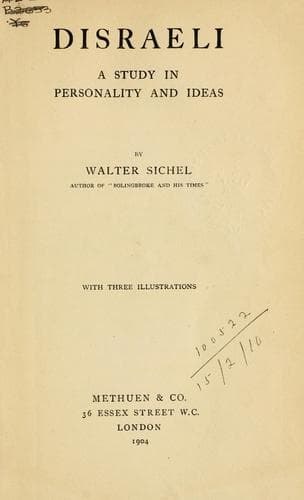
Disraeli: A Study in Personality and IdeasSichel, Walter
History
Disraeli: A Study in Personality and Ideas
Sichel, Walter
Disraeli, Benjamin, 1804-1881
This purpose he had sought to accomplish two years before, when, in
1848, he proved by a speech which, it is said, won him the eventual
leadership of his party, that the breakdown which Carlyle was at that
time preparing to denounce, was due to an incapable ministry, and not
to an effete Parliament. He always held Parliament to be neither a
municipal vestry nor a chamber of commerce, but a national temple of
embodied opinion; nor can the wisdom of his view in those dark and
despondent times be better tested than by comparing, in the light of
what has since occurred, than by contrasting Carlyle’s fulminations in
this regard with Disraeli’s discernment.
“... There is a phenomenon,” says Carlyle, in his “Chartism,” “which
one might call Paralytic Radicalism in these days, which gauges with
statistic measuring-reed, sounds with Philosophic Politico-Economic
plummet, the deep, dark sea of trouble, and, having taught us rightly
what an infinite sea of trouble it is, sums up with the practical
inference and use of consolation, That nothing whatever in it can be
done by man, who has simply to sit still and look wistfully to ‘Time
and General Laws;’ and thereupon, without so much as recommending
suicide, coldly takes its leave of us....”
Disraeli, on the other hand--
“... ‘In this country,’ said ‘Sidonia,’ ‘since the peace, there has
been an attempt to advocate a reconstruction of society on a purely
rational basis. The principle of Utility has been powerfully developed.
I speak not with lightness of the labours of the disciples of that
school. I bow to intellect in every form; and we should be grateful to
any school of philosophers, even if we disagree with them.... There
has been an attempt to reconstruct society on a basis of material
motives and calculations. It has failed. It must ultimately have failed
under any circumstances; its failure in an ancient and densely peopled
kingdom was inevitable. How limited is human reason, the profoundest
inquirers are most conscious. We are not indebted to the reason of man
for any of the great achievements which are the landmarks of human
action and human progress. It was not Reason that besieged Troy; it was
not Reason that sent forth the Saracen from the desert to conquer the
world, that inspired the crusades, that instituted the monastic order;
it was not Reason that produced the Jesuits; above all, it was not
Reason that created the French Revolution....”
I may compare with this the light episode of the travelling Utilitarian
in the much earlier _Young Duke_--
“... ‘I think it is not very difficult to demonstrate the _use_ of an
aristocracy,’[68] mildly observed the Duke.
“‘Pooh! nonsense, sir! I know what you are going to say, but we have
got beyond all that. Have you read this, sir? This article on the
aristocracy in _The Screw and Lever Review_?’
“‘I have not, sir.’
Public-domain text, read in full here on John Shaqi.
Reviews
Reviews
No reviews yet
Be the first to share your thoughts on this work.
Elsewhere in the archive
Join the Discussion
Join the discussion
Sign in to leave a comment or review.
Sign InorCreate an account