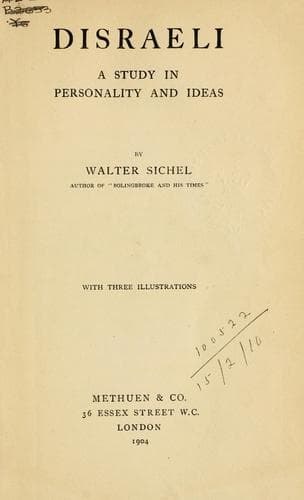
Disraeli: A Study in Personality and IdeasSichel, Walter
History
Disraeli: A Study in Personality and Ideas
Sichel, Walter
Disraeli, Benjamin, 1804-1881
“‘Then I advise you to make yourself master of it, and you will talk no
more of the aristocracy. A few more articles like this, and a few more
noblemen like the man who has got this park, and people will open their
eyes at last.’
“‘I should think,’ said his Grace, ‘that the follies of the man who has
got this park have been productive of evil only to himself. In fact,
sir, according to your own system, a prodigal nobleman seems to be a
very desirable member of the commonwealth, and a complete leveller.’
“‘We shall get rid of them all soon, sir....’
“‘I have heard that he is very young, sir,’ remarked the widow.
“‘Ah, youth is a very trying time! Let us hope the best. He may turn
out well yet, poor soul!’
“‘I hope not. Don’t talk to me of poor souls. There is a poor soul,’
said the Utilitarian, pointing to an old man breaking stones on the
highway. ‘That is what I call a poor soul, not a young prodigal....’”
No one who has followed the labour movement in England, or the
social-democrat organisations in Germany and France, can fail to
recognise the immense part that personality, imagination, and desire
of power plays in them, and how completely, in their instance,
utilitarianism has broken down. Utilitarianism, of course, ignores the
moral and imaginative aspects. It mistakes the moon for a cream-cheese.
It ignores personal influence. Above all, it confounds happiness with
prosperity. “Charcoal,” exclaims Ruskin (here in complete accord with
Disraeli), “may be cheap among your roof-timbers after a fire, and
bricks may be cheap in your streets after an earthquake; but fire and
earthquake may not therefore be national benefits.” Even in a concern
purely commercial, reserve must be weighed against dividends.
Again, as regards this very Reform Bill of 1832, and the stagnant
formulæ of its pioneer, I will again invoke Carlyle--
“... An ultra-radical, not seemingly of the Benthamee species, is
forced to exclaim, ‘The people are at last wearied! They say, “Why
should we be ruined in our shops, thrown out of our farms, voting for
these men?” Ministerial majorities decline; this Ministry has become
impotent, had it even the will to do good. They have long called to us,
“We are a Reform Ministry; will ye not support _us_?” We have supported
them, borne them forward indignantly on our shoulders time after time,
fall after fall, when they had been hurled out into the street, and
lay prostrate, helpless, like dead luggage. It is the fact of a Reform
Ministry, not the name of one, that we would support.... The public
mind says at last, Why all this struggle for the _name_ of a Reform
Ministry? Let the Tories be a ministry, if they will; let, at least,
some living reality be a ministry!’...”
Public-domain text, read in full here on John Shaqi.
Reviews
Reviews
No reviews yet
Be the first to share your thoughts on this work.
Elsewhere in the archive
Join the Discussion
Join the discussion
Sign in to leave a comment or review.
Sign InorCreate an account