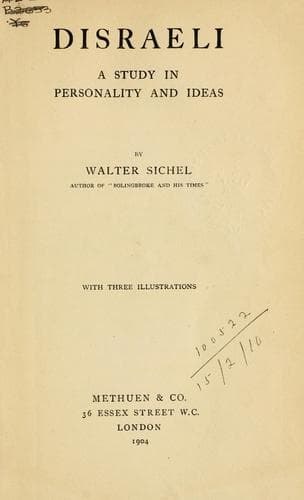
Disraeli: A Study in Personality and IdeasSichel, Walter
History
Disraeli: A Study in Personality and Ideas
Sichel, Walter
Disraeli, Benjamin, 1804-1881
“Amid these conflicting statements,” he continues, “it is singular
that no member of either House should have recurred to the original
character of these popular assemblies which have always prevailed among
the northern nations.... When the crowned northman consulted on the
welfare of his kingdom, he assembled the estates of his realm. Now, an
estate is a class of the nation invested with political rights. Then
appeared the estate of the clergy, of the barons, of other classes.
In the Scandinavian kingdoms to this day the estate of the peasants
sends its representatives to the Diet. In England, under the Normans,
the Church and the Baronage were convoked together with the estate
of the Community, a term which then probably described the inferior
holders of land whose tenure was not immediate of the Crown. The Third
Estate was so numerous that convenience suggested its appearance by
representation, while the others, more limited, appeared, and still
appear, personally. The Third Estate was reconstructed as circumstances
developed themselves. It was a reform of Parliament when the towns were
summoned. In treating the House of the Third Estate as the House of
the People, and not as the House of a privileged class, the Ministry
and Parliament of 1831 virtually conceded the principle of universal
suffrage. In this point of view, the ten-pound franchise was an
arbitrary, irrational, impolitic qualification. It had indeed the merit
of simplicity, and so had the constitution of Abbé Sièyes. But its
immediate and inevitable result was Chartism.
“But if the Ministry and Parliament of 1831 had announced that the time
had arrived when the Third Estate should be enlarged and reconstructed,
they would have occupied an intelligible position; and if, instead of
simplicity of elements in its reconstruction, they had sought, on the
contrary, varying and various materials which would have neutralised
the painful predominance of any particular interest in the new scheme,
and prevented those banded jealousies which have been its consequence,
the nation would have found itself in a secure position. Another class,
not less numerous than the existing one, and invested with privileges
not less important, would have been added to the public estates of the
realm, and the bewildering phrase, ‘the People,’ would have remained
what it really is, a term of natural philosophy, and not of political
science.”
* * * * *
The quality, then, of excellence, instead of the majorities of
multitude, the variety of every approved influence, and not the undue
weight of any overwhelming interest--these formed for him the true
bases of representation. He was ever for levelling up instead of down;
and, as we shall see, he was directly opposed to Mr. Hume’s fallacy
(still rampant) that by our traditions representation depends only on
taxation.
Public-domain text, read in full here on John Shaqi.
Reviews
Reviews
No reviews yet
Be the first to share your thoughts on this work.
Elsewhere in the archive
Join the Discussion
Join the discussion
Sign in to leave a comment or review.
Sign InorCreate an account