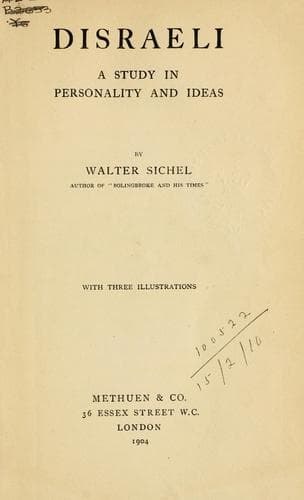
Disraeli: A Study in Personality and IdeasSichel, Walter
History
Disraeli: A Study in Personality and Ideas
Sichel, Walter
Disraeli, Benjamin, 1804-1881
In 1834 he denounced “the Whig system of centralisation,” and their
organised attempt to “overpower” the House of Lords and to despotise
the House of Commons, while of their subsequent disorganisation from
within, because of the failure of concerted opposition from without, he
gave that surpassing simile of Ducrow’s Circus. In 1835 he pursued the
subject of constitutional opposition, and he expressed his dread, as
he did in 1881, that if the Whigs remained “our masters for life, the
dismemberment of the Empire” might follow. And all this in the teeth of
what was then considered a system installed for fifty years, and which
would have promised him a personal triumph had he appeared then to
have chosen to have endorsed it.
But the views he always retained as to the first principles of
representation are best heard in a passage from _Coningsby_.
“... In the protracted discussions to which this celebrated measure
gave rise, nothing is more remarkable than the perplexities into which
the speakers on both sides are thrown when they touch upon the nature
of the representative principle. On the one hand, it was maintained
that under the old system the people were virtually represented, while,
on the other, it was triumphantly urged that, if the principle was
conceded, the people should not be virtually, but actually represented.
But who are the people? And where are you to draw a line? And why
should there be any? It was urged that a contribution to the taxes was
the constitutional qualification for the suffrage.” Here is repeated
what he had urged in the ’thirties, and was to reiterate in the
’fifties, that indirect taxation is as much taxation as direct; that
“the beggar who chews his quid as he sweeps a crossing is contributing
to the imposts; ... he is one of the people, and he yields his quota
to the public burthens.” The logical inference of such a qualification
must be to convert the suffrage from being a privilege into being a
right. Manhood suffrage, in common with all privilege unearned, is
usually prized by none, and even disregarded by most.
Public-domain text, read in full here on John Shaqi.
Reviews
Reviews
No reviews yet
Be the first to share your thoughts on this work.
Elsewhere in the archive
Join the Discussion
Join the discussion
Sign in to leave a comment or review.
Sign InorCreate an account