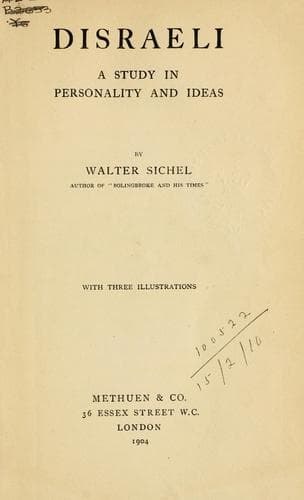
Disraeli: A Study in Personality and IdeasSichel, Walter
History
Disraeli: A Study in Personality and Ideas
Sichel, Walter
Disraeli, Benjamin, 1804-1881
Again, in 1865, “... It appears to me,” urged Disraeli, “that the
primary plan of our ancient constitution, so rich in various wisdom,
indicates the course that we ought to pursue in this matter. It secured
our popular rights by entrusting power, not to an indiscriminate
multitude, but to the estate, or order, of the Commons. And a wise
government should be careful that the elements of that estate _should
bear a close relation to the moral and material development of the
country_. Public opinion may not yet, perhaps, be ripe enough to
legislate as to the subject, but it is sufficiently interested in
the question to ponder over it with advantage; so that, _when the
time comes for action_, we may legislate in the spirit of the English
Constitution, _which would absorb the best of every class_, and not
fall into a ‘democracy’ which is the tyranny of one class, and that
_one the least enlightened_.”
Long before 1867, these continuous utterances culminated that typical
speech of 1859, which mooted a comprehensive plan of enlarged
representation of political power, yet undisturbed balance, and which
would have made “a representative assembly that is a mirror of the mind
as well as of the material interests of England.”
I shall quote largely from this unfamiliar speech. It illustrates
how far his lifelong principles applied to a juncture before the
artisans were wholly free from agitation against monarchy, and those
institutions which fence it round. All Radical schemes, compassing
“manhood suffrage,” all Whig schemes, merely delaying its day by
seeking to reduce rental or property qualifications to an arbitrary
minimum, were his aversion. Set, as he always was, against including
whatever at the moment formed the dregs of ignorance, or the sediment
of an unentitled populace, he already favoured that “rating” basis
which Lord John Russell, always constitutional, had himself propounded
in his abortive plan of 1854, and which Disraeli was to carry out
in 1867 as a safeguard of stability in the boroughs. But in 1859
Lord Derby did not consider its application feasible. Disraeli
had, therefore, now to forego it. Refusing to make any reductions
in the franchise, or yield an inch to “detached” democracy, he now
proposed to attain steadiness, to vary the vote, and to represent
enlightenment contrasted with mere property by recommending the
creation of the “compound householder” (“dwellers in a portion of
any house rented in the aggregate at £20”)[72]; by a new suffrage
for several small ownerships of property in the funds and savings
banks; and for education, by enfranchising graduates, ministers of
religion, physicians, barristers, and certain school-masters. He thus
both forecasted, so far as was then practicable, household suffrage
as against household democracy; and at the same time sought to
represent education and ensure variety. By his attendant scheme of
redistribution, he tried to prevent the counties from being “swamped”
Public-domain text, read in full here on John Shaqi.
Reviews
Reviews
No reviews yet
Be the first to share your thoughts on this work.
Elsewhere in the archive
Join the Discussion
Join the discussion
Sign in to leave a comment or review.
Sign InorCreate an account