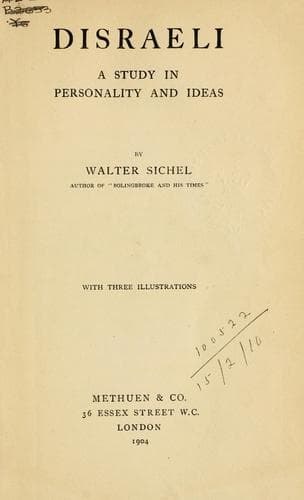
Disraeli: A Study in Personality and IdeasSichel, Walter
History
Disraeli: A Study in Personality and Ideas
Sichel, Walter
Disraeli, Benjamin, 1804-1881
by the towns, while at the same time he jealously guarded the local
independence of the boroughs. His purpose was to protect the country
districts against that invasion from the cities of agrarian demagogues
which, after his death, the stride forward of 1884 was to impel.[73]
But “finality is not the word of politics.” Progress changes
possibilities. He had to wait till the pear was ripe; till the working
man had been really reconciled to monarchy and its institutions; till
the ground had been laid for a generous scheme of national education,
and cleared by the sharply defined position of parties, which at last
brought into relief the issues between democracy as a due element and
as a domineering class. Nor, if he were now alive, would he fail to
discern that the appeal of present imperialism to present democracy
will be dangerous if made to it as a deciding class before it has
acquired the governing faculty by long apprenticeship. Democracy as
a leaven, democracy as the lump, are obviously distinct. The one
is “popular and national,” the other despotic or cosmopolitan. Our
artisans are now intensely national and patriotic; but the “submerged
tenth” would soon show themselves tyrants over the community.
* * * * *
The pith of his argument is that mere numbers can never form the ground
of representation, which should rest on influence even more than
interest.
“... It appears to me that those who are called parliamentary reformers
may be divided into two classes. The first are those ... who would
adapt the settlement of 1832 to the England of 1859, and would act in
the spirit and according to the genius of the existing constitution....
But, sir, it would not be candid, and it would be impolitic not to
acknowledge that there is another school of reformers having objects
very different from those which I have named. The new school, if I
may so describe them, would avowedly effect a parliamentary reform on
principles different from those which have hitherto been acknowledged
as forming the proper foundations for this House. The new school of
reformers are of opinion that the chief, if not the sole, object of
representation is to realise the opinion of the numerical majority of
the country. Their standard is _population_, and I admit that their
views have been clearly and efficiently placed before the country.
Now, sir, there is no doubt that population is, and must always be,
one of the elements of our representative system. There is also such
a thing as property, and that too must be considered. I am ready to
admit that the new school have not on any occasion limited the elements
of their representative system solely to population. They have, with
a murmur, admitted that property has an equal claim to consideration;
but then, they have said that _property and population go together_.
Well, sir, population and property do go together--in statistics, but
in nothing else.
Public-domain text, read in full here on John Shaqi.
Reviews
Reviews
No reviews yet
Be the first to share your thoughts on this work.
Elsewhere in the archive
Join the Discussion
Join the discussion
Sign in to leave a comment or review.
Sign InorCreate an account