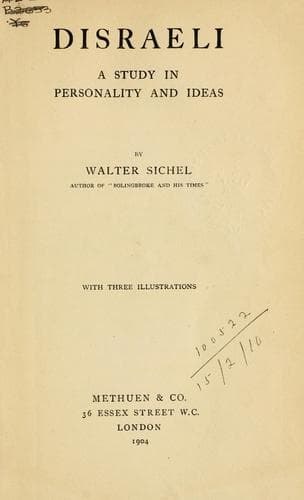
Disraeli: A Study in Personality and IdeasSichel, Walter
History
Disraeli: A Study in Personality and Ideas
Sichel, Walter
Disraeli, Benjamin, 1804-1881
“Why, sir, the power of the city of London or that of the city of
Manchester in this House is not to be measured by the honourable
and respectable individuals whom they send here to represent their
opinions. I will be bound to say that there is a score--nay, that
there are threescore--members in this House who are as much and more
interested, perhaps, in the city of Manchester than those who are in
this House its authoritative and authentic representatives.... Look at
the metropolis itself, not speaking merely of the city of London. Is
the influence of the metropolis in this House to be measured by the
sixteen honourable members who represent it?... ... So much for that
principle of population, or that principle of property, which has been
adopted by some; or that principle of population and property combined,
which seems to be the more favourite form.... There is one remarkable
circumstance connected with the new school, who would build up our
representation on the basis of a numerical majority, and who take
population as their standard. It is this--that none of their principles
apply _except in cases where population is concentrated_. The principle
of population is ... a very notorious doctrine at the present moment,
but it is not novel.... It was the favourite argument of the late Mr.
Hume.... The principle, in my opinion, is false, and would produce
results dangerous to the country and fatal to the House of Commons. But
if it be true, ... then I say you must arrive at conclusions entirely
different from those which the new school has adopted. If population is
to be the standard, and you choose to disfranchise small boroughs and
small constituencies, it is not to the great towns you can, according
to your own principles, transfer their members....
“Let us now see what will be the consequence if the population
principle is adopted. You would have a House, generally speaking,
formed partly of great landowners and partly of great manufacturers.
I have no doubt that, whether we look to their property or to their
character, there would be no country in the world which could rival in
respectability such an assembly. But would it be a House of Commons;
would it represent the country; would it represent the various
interests of England? Why, sir, after all, the suffrage and the seat
respecting which there is so much controversy and contest, _are only
means to an end.... You want in this House every element that obtains
the respect and engages the interest of the country.... You want a
body of men representing the vast variety of the English character;
men who would arbitrate between the claims of those great predominant
interests; who would temper the acerbity of their controversies. You
want a body of men to represent that considerable portion of the
community who cannot be ranked under any of those striking and powerful
heads to which I have referred, but who are in their aggregate equally
important and valuable, and perhaps as numerous._”
Public-domain text, read in full here on John Shaqi.
Reviews
Reviews
No reviews yet
Be the first to share your thoughts on this work.
Elsewhere in the archive
Join the Discussion
Join the discussion
Sign in to leave a comment or review.
Sign InorCreate an account