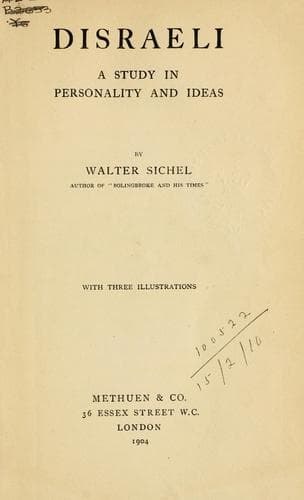
Disraeli: A Study in Personality and IdeasSichel, Walter
History
Disraeli: A Study in Personality and Ideas
Sichel, Walter
Disraeli, Benjamin, 1804-1881
He then adverted to the borough system as an indirect machinery for
this purpose, and contended that those who would sweep it away must
substitute “machinery as effective.” “... Now,” he continued, “there
is one remarkable feature in the agitation of the new school.... They
offer no substitute whatever.... I will tell you what must be the
natural consequence of such a state of things. The House will lose, as
a matter of course, its hold on the Executive. The House will assemble.
It will have men sent to it, no doubt, of character and wealth; and
having met here, they will be unable to carry on the Executive of the
country. Why? Because the experiment has been tried in every country,
and the same result has occurred; _because it is not in the power of
one or two classes to give that variety of character and acquirement
by which the administration of a country can be carried on_. Well,
then, what happens? _We fall back on a bureaucratic system_,[74] and
we should find ourselves, after all our struggles, in the very same
position from which, in 1640, we had to extricate ourselves. Your
administration would be carried on by a court minister, perhaps by a
court minion. It might not be in these times, but in some future time.
The result of such a system would be to create an assembly where the
members of Parliament, though chosen by great constituencies, would
be chosen from limited classes, and perhaps only from one class of
the community....” His own prescription for breaking monotony, he
described as “lateral,” not “vertical” extension.
Disraeli determined to settle this question himself, and to settle
it by the admission to the franchise of the “working” classes of the
country, and not by lowering it to the “man in the street,” or the
submerged tenth. In these views he followed the Toryism of Cobbett
rather than the Radicalism of Hume. Discussing Lord John Russell’s
proposals of 1860 “for the representation of the people” (which,
though it adopted the principle of rateability, was, in fact, merely a
reduction of the borough franchise to £6, and of the county occupation
to £10), Disraeli labelled its “simplicity” as “of a mediæval
character, but without any of the inspiration of the feudal system, or
any of the genius of the middle ages.” It sought only to scale down
a property qualification. The “claims of intelligence, acquirement,
and education” were ignored. As regarded the borough franchise, not
fitness, but number was the principle; and the numerical addition
accrued to one class only.
Public-domain text, read in full here on John Shaqi.
Reviews
Reviews
No reviews yet
Be the first to share your thoughts on this work.
Elsewhere in the archive
Join the Discussion
Join the discussion
Sign in to leave a comment or review.
Sign InorCreate an account