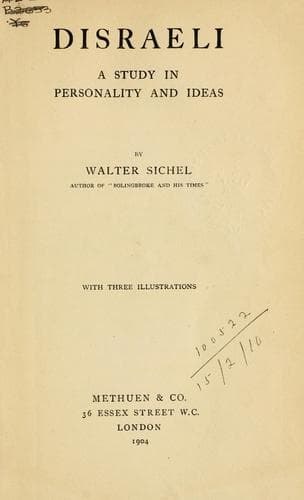
Disraeli: A Study in Personality and IdeasSichel, Walter
History
Disraeli: A Study in Personality and Ideas
Sichel, Walter
Disraeli, Benjamin, 1804-1881
In his resolve to spread the franchise in his own manner, and to
neutralise the revolutionary bias of agitators and secret societies,
he never lost sight of the growing force of public opinion. He himself
was “a gentleman of the press;” in the improved and multiplied
newspapers he hailed the great safety-valve afforded to England by
that “publicity” on which “the great fabric of political freedom” has
been reared. “Free intercourse,” he exclaimed in the ’thirties, “is
the spirit of the age!” So late as 1872, he observed, “... That has
been the principle of the whole of our policy. First of all, we made
our courts of law public, and during the last forty years we have
completely emancipated the periodical press of England, which was
not literally free before, giving it such power that it throws light
upon the life of almost every class in this country, and I might say
upon the life of almost every individual.” In the press (the light of
which he perhaps valued more than the warmth), he welcomed an antidote
against hidden and perilous associations; and believed that if the
self-respecting hand-labourer received the vote (as he was entitled to
do), he would exercise it in the cause of freedom, of loyalty, and of
order. In 1862, he declared “parliamentary discipline founded on its
only sure basis, sympathising public opinion,” to be the watchword of
his propaganda. The passage summarises much that I have discussed.
“... To build up a community, not upon Liberal opinions, which any man
may fashion to his fancy, but upon popular principles which assert
equal rights, civil and religious; to uphold the institutions of the
country because they are the embodiment of the wants and wishes of
the nation, and protect us alike from individual tyranny and popular
outrage; equally to resist democracy” (as a form of government) “and
oligarchy, and to favour that principle of _free aristocracy_ which
is the only basis and security for constitutional government; ...
to favour popular education, because it is the best guarantee of
public order; to defend local government, and to be as jealous of
the rights of the working man as of the prerogative of the Crown and
the privileges of the senate;--these were once the principles which
regulated Tory statesmen (_i.e._ Bolingbroke and Wyndham), and I for
one have no wish that the Tory party should ever be in power unless
they practise them.”
In his great speech during the summer of the following year on “popular
principles” and “liberal opinions,” as well as on the introduction of
his actual Reform Bill, he gave expression once more to his distinction
between “popular privileges” and “democratic rights”--
Public-domain text, read in full here on John Shaqi.
Reviews
Reviews
No reviews yet
Be the first to share your thoughts on this work.
Elsewhere in the archive
Join the Discussion
Join the discussion
Sign in to leave a comment or review.
Sign InorCreate an account