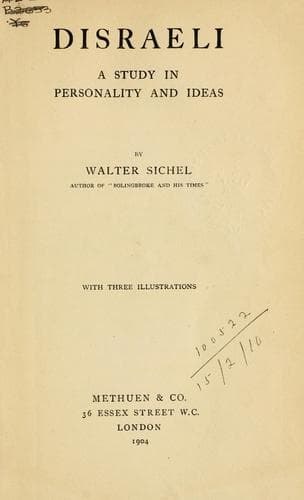
Disraeli: A Study in Personality and IdeasSichel, Walter
History
Disraeli: A Study in Personality and Ideas
Sichel, Walter
Disraeli, Benjamin, 1804-1881
“... If the measure bears some reference to the existing classes in
this country, why should we conceal from ourselves that _this country
is a country of classes, and a country of classes it will ever remain_?
What we desire to do is to give every one who is worthy of it a fair
share in the government of the country by means of the elective
franchise; but at the same time we have been equally anxious to
maintain the character of the House....”
As a matter of tactics, Disraeli had of design framed the bill on
lines stricter than he was prepared to concede. He desired that the
re-settlement should be enduring, and he deliberately appealed to the
co-operation of both parties for this purpose. He had “leaped in the
dark,” he had “shot Niagara.” The storm of obloquy, desertion, and
censure broke over his head, but he was unmoved, because his proposals
were based on principles long held and patiently matured. Of the lodger
franchise he had long ago been the “father.” An unmitigated household
franchise he refused as too “democratic.” The “direct taxation”
franchise and the “dual vote,” which were intended as barriers for the
middle classes, he surrendered. That educational franchise which was
bound up with a cause that from boyhood had been dear to him; that
“savings-bank” franchise which established the right of industrial
thrift to representation, he was forced to abandon, by the clamour of
the very party that desired education without religion, and labour
as the mere instrument of capital. Looking back impartially, these
derided “fancy franchises” seem to me a deplorable loss, and even now
it would be well to recognise that the mind and the character should
have representative faculties wholly apart from the power of property.
Disraeli was forced to cast them overboard that he might preserve
the vessel itself during the party hurricane. But the essential
qualifications of residence and rateability he maintained in the teeth
of Mr. Gladstone, and under all the modifications of the principle
which ensued. His mind was fixed to steer between the extremes alike of
those who, under the mask of emancipation, purposed the despotism of a
single class, and of those who desired to form the government of this
country by the caprice of an irresponsible, an unintelligent, and an
indiscriminate multitude. And he proved his earnest sincerity by the
appeal which closed his speech on the second reading: “_Pass the bill,
and then change the ministry if you like_.”
Public-domain text, read in full here on John Shaqi.
Reviews
Reviews
No reviews yet
Be the first to share your thoughts on this work.
Elsewhere in the archive
Join the Discussion
Join the discussion
Sign in to leave a comment or review.
Sign InorCreate an account