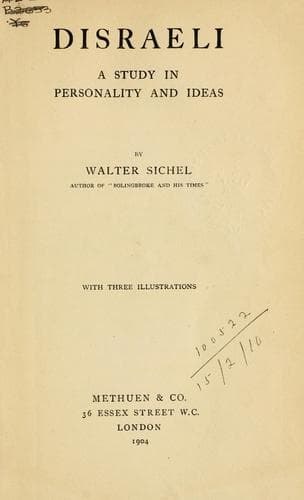
Disraeli: A Study in Personality and IdeasSichel, Walter
History
Disraeli: A Study in Personality and Ideas
Sichel, Walter
Disraeli, Benjamin, 1804-1881
No memorial of Disraeli’s magical career can be adequate without access
to the papers confided to the late Lord Rowton, as well as to much
private and unpublished correspondence. It is no slur on the “Lives”
that have already appeared to say that they lack the materials for a
complete picture. The best of these beyond question is Mr. Froude’s;
but not only is it tinged with considerable prejudice, but it is
very faulty in its facts; and, moreover, in common with Mr. Bryce’s
cursory essay and Herr Brandes’s minuter study, it has perhaps fallen
into the error of misreading Disraeli’s mature character and career
from isolated and indiscriminate use of such sidelights as they are
pleased to discover in his earliest novels. To trace Disraeli’s
development, it is necessary to follow the long and continuous thread
of his words and actions, to consider the changes experienced during
the fifty years of his political outlook in England and in Europe, and
to ascertain how many of these tendencies were foreseen, produced, or
modified by him. The criticisms current are either those of men (often
partisans) who lack this length of view, and interpret the latter
manifestations of Disraeli’s genius, with which alone they are even
outwardly acquainted, in the light of preconceived notions, or the
few circulated comparatively early in his career, before its eventual
drift was revealed, and while the full blaze of hostile bitterness was
raging. There exists, it is true, a most able, a most appreciative, a
most detailed account of his political career, compiled by Mr. Ewald
shortly after Lord Beaconsfield’s death, but this is mainly a long
parliamentary chronicle. Mr. Kebbel’s enlightening edition of selected
speeches is illustrative though limited. To both of these, among many
other sources, direct and indirect, I here gratefully acknowledge my
obligation.
A real biography, therefore, is at present impossible. Disraeli’s
acknowledged debt to his darling sister and devoted wife (“Women,” he
has said, “are the priestesses of pre-destination”); his correspondence
and commerce with many eminent men, including both Louis Philippe and
Napoleon III.; his letters to our late Queen; his notes of policy;
the rough drafts for compositions, both literary and parliamentary;
his State papers and official memoranda; his relations to many men of
letters and leading; such known, though unpublished, correspondence as
even that with Mrs. Williams; the glimpses of him as a youth through
Mrs. Austin, Bulwer, Lord Strangford, the Sheridans, with many others;
in his age, through a privileged circle of distinguished and devoted
associates--all these, and many more, must be pressed into service
if even the rudiments are to be portrayed. And none of these are yet
available.
Public-domain text, read in full here on John Shaqi.
Reviews
Reviews
No reviews yet
Be the first to share your thoughts on this work.
Join the Discussion
Join the discussion
Sign in to leave a comment or review.
Sign InorCreate an account