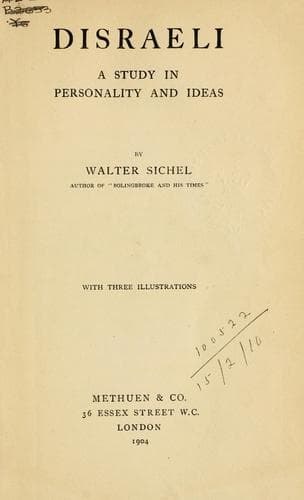
Disraeli: A Study in Personality and IdeasSichel, Walter
History
Disraeli: A Study in Personality and Ideas
Sichel, Walter
Disraeli, Benjamin, 1804-1881
It is not within my province to track the maze of altercations which
attended every step of a bill on which Disraeli, contrary to his
wont, spoke more than three hundred times, or to raise the dust of
controversy this year revived. But, were it so, I could prove how
faithful Disraeli remained to the central ideas which had animated
him from his youth. So far from having passed a “liberal” measure, he
had passed under colossal difficulties, that for which he had long
striven, and in a manner which remedied the defects of 1832 without
endangering the repose of the State. Indeed, for the second time he
actually re-created the Conservative party, and, to the surprise of
some of his friends and all his enemies, discovered in the unknown
region of the toilers, with whom he had ever sympathised, whom he
had always trusted, but whom the Whigs had driven to revolt, and to
whom the “cheapest market” Radicals perpetually begrudged protection,
health, and alleviation--discovered, I say, in these elements--the
pawns of ignoble partisanship--his truest props of order and of
allegiance. The measure and the events of 1884 were to prove the
rightness alike of his confidence and of his caution. The counties with
a lowered franchise became a prey to agitators. The towns remained
staunch and steadfast. And this, though in 1867 Mr. Bright had sneered
at Disraeli for having “lugged” his “omnibus” of stupid squires up the
hill of democracy.
In his speech of 1859, Disraeli protested against any “predominance of
household democracy.” He kept his word. Speaking at Edinburgh in the
autumn of 1867, he remarked on this very topic--
“... It may be said you have established a democratic government in
England, because you have established household suffrage, and you have
gone much further than the measures which you previously opposed....
Now, I am not at all prepared to admit that household suffrage with the
constitutional conditions upon which we have established it--namely,
residence and rating--has established a democratic government. But it
is unnecessary to enter into that consideration, because we have not
established household suffrage in England. There are, I think I may
say, probably four million houses in England. Under our ancient laws,
and under the Act of Lord Grey, about one million of those householders
possessed the franchise. Under the Act of 1867, something more than
half a million will be added to that million. Well, then, I want to
know if there are four million householders, and one and a half million
in round numbers possess the suffrage, how can ‘household suffrage’ be
said to be established in England?”
Public-domain text, read in full here on John Shaqi.
Reviews
Reviews
No reviews yet
Be the first to share your thoughts on this work.
Elsewhere in the archive
Join the Discussion
Join the discussion
Sign in to leave a comment or review.
Sign InorCreate an account