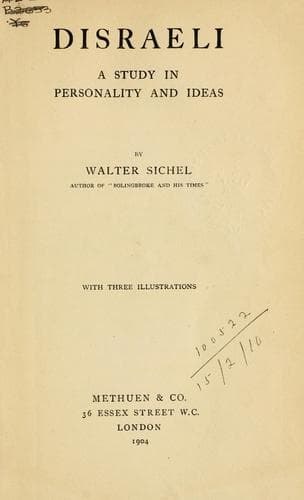
Disraeli: A Study in Personality and IdeasSichel, Walter
History
Disraeli: A Study in Personality and Ideas
Sichel, Walter
Disraeli, Benjamin, 1804-1881
The mistrust of this great measure at the time, even by men of
intelligence, may be justified by the objection that in the distant
future Labour may resume its war against authority in its coming
conflict with Capital; and that a rigid conservatism of defiance is
preferable to an adaptive conservatism of development. But whenever
that hour strikes, it will be seen that Disraeli’s statesmanship
has prevented the revolution which a conservatism of defiance must
have prepared and entailed. Disraeli will have helped to preserve
the English immunity from the violences which mark such upheavals
elsewhere. He sought with all his might to quicken Capital into duty,
and to hearten Labour by conferring privilege, not as a sop, but as a
reward, while, by alleviating misery through creative enactments, he
has conservatised Labour and kept it in touch with the national scheme.
It may not, perhaps, have been wholly realised how harmonious
Disraeli’s utterances respecting the progressive principles of
representation in England have been. That is my excuse for treating
the subject with insistence, though by no means with completeness. To
have done so would risk the exhaustion of the reader as well as of the
subject. Disraeli prevented the raid of alien and disruptive democracy
from making England a home. Out of the common he extracted the choice.
He revived the democracy long inherent in the English Constitution; he
naturalised the democratic idea on the soil of tradition and order; and
thereby he cemented the solidarity of the State and the welfare of the
nation. He proved that “progress” is not synonymous with push, and that
in going forward it is wise also to look back, lest the goal should be
a precipice. Still, long as this disquisition has necessarily been, I
may hope that it is not dull, since, in Mrs. Malaprop’s aphorism, “I
don’t think there is a superstitious article in it.”
CHAPTER III
LABOUR--“YOUNG ENGLAND”--“FREE TRADE”
Public-domain text, read in full here on John Shaqi.
Reviews
Reviews
No reviews yet
Be the first to share your thoughts on this work.
Elsewhere in the archive
Join the Discussion
Join the discussion
Sign in to leave a comment or review.
Sign InorCreate an account