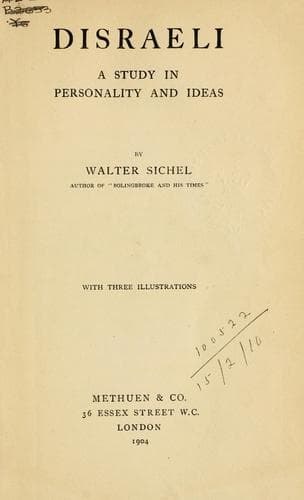
Disraeli: A Study in Personality and IdeasSichel, Walter
History
Disraeli: A Study in Personality and Ideas
Sichel, Walter
Disraeli, Benjamin, 1804-1881
In _Vivian Grey_, Disraeli mocks at the attitude of the early political
economists towards Labour in the person of “Mr. Toad,” who defined it
as “that exertion of mind or body which is not the involuntary effect
of the influence of natural sensations.” In the second of his long
series of election addresses, he promised to “withhold his support
from every ministry which will not originate some great measure to
ameliorate the condition of the lower orders, ... to liberate our
shackled industry....” The subject is closely allied to much already
surveyed. Here, however, I shall for the most part leave politics
alone, and confine myself mainly to the social aspects of the question,
for from this standpoint he himself approached it. On Mr. Villiers’
resolutions in 1852, he distinctly stated that he and his friends had
opposed the repeal of the Corn Laws on the main ground that it would
“prove injurious to the interests of Labour;” on the subsidiary ground
that it would injure “considerable interests in the country.” He had,
two years before, urged that it “was a question of labour, or it was
nothing.” Even in the _Revolutionary Epick_, fifteen years earlier, he
had sung, “The many labour, and the few enjoy.”
The extracts given in the preceding chapter from Disraeli’s speech
on Mr. Hume’s motion in 1848, illustrate the central ideas which he
enforced with singular pertinacity in all his published works and
public utterances.
They are mainly these.
It was an age of emancipation, and Peel liberated commerce. In so
doing he disjointed Labour. His two great reforms--that of the Tariff
and that of the Corn Laws--designed as inter-remedial, were certainly
calculated to disturb and dislocate Labour, the one by unloosing the
full forces of straining competition; the other by revolutionising the
centres of industry, by transferring population from the country to the
city, by impairing the landed interests, both high and low, by shifting
the distribution of toil. At the very moment before his relaxation of
the Corn Laws, Peel, conscious that he would disorganise Labour,[75]
had been unconsciously converted to the “right to physical happiness”
system of Manchester--the dryest embodiment of the theory of the French
“physical” equalitarians, on which I touched in my last chapter. His
economics of “cheapness,” the results of which he feared in relation to
the distribution of employment, thus became associated with a principle
that, as I have shown, demands “unlimited employment of labour.” He
freed Commerce, but he unsettled Labour, already rebelling against
the harsh workings of the new Poor Laws. Disraeli asked himself if
reduced tariffs would augment purchasing power, if dethroned land
would be succeeded by any novel power for alleviating the Labour thus
unhinged. And, further, he asked whether the middle class of 1846
would not reap the benefit without bearing the burden, just as it had
done in the Reform of 1832. What would be the effect of discontent on
Public-domain text, read in full here on John Shaqi.
Reviews
Reviews
No reviews yet
Be the first to share your thoughts on this work.
Elsewhere in the archive
Join the Discussion
Join the discussion
Sign in to leave a comment or review.
Sign InorCreate an account