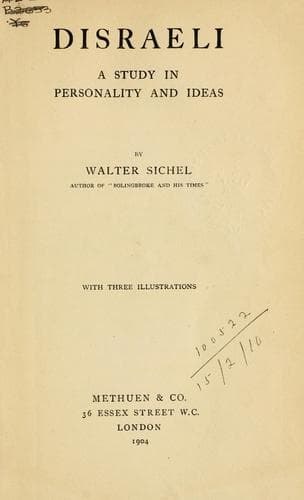
Disraeli: A Study in Personality and IdeasSichel, Walter
History
Disraeli: A Study in Personality and Ideas
Sichel, Walter
Disraeli, Benjamin, 1804-1881
the institutions of the country? The two great problems during the
whole decade of 1830-40, when there had occurred a real renaissance,
an awakening, had been Democracy and the Church. Was Democracy to
be detached from the order and orders of the State? was it to be an
anti-national solvent? And was the Church to realise its mission as
a society of believers instead of being perverted into a library of
assent? So far Chartism and Apostasy had been the answers. Were Sir
Robert Peel’s arithmetical measures, excellent as they were in theory,
any practical power for regeneration? Chartism’s inner causes had been
both the want of employment and the despair of the employed. In 1840,
he proclaimed, to his leader’s dismay, his deep sympathy, not with
Chartism, “but with the Chartists,” preyed on by ambitious leaders,
and victimised by official indifference. Throughout he regarded the
whole “condition of England” question from its moral and social
standpoints--to which economics should be subordinate--as touching
Labour at one end and Leadership at the other.
The claims of Labour, he says, are paramount as those of property.
Property and Labour should be allies, and not foes; nay, Labour is
itself the property of the poor, out of which the property of the rich
is accumulated. The gentlemen of England should form the advanced guard
of Labour; and, moreover, the master-workmen themselves compose “a
powerful aristocracy.” So long as property was allied both to land and
manufacture, a feeling of public spirit and public duty in the main
characterised the large employers. But a financial oligarchy was bound
to arise, and has arisen, linked by no visible ties to the workers,
and generous more by gifts of “ransom” than by personal participation;
a system of commerce, too, without leaders, which now works in groups
and merely on “cheapest market” principles, has sprung into being. And,
moreover, the vast multiplication of machines tended all along, and
tends more and more with the huge increase of intercommunication, to
exalt mechanism into life and to degrade the labourer into a machine,
himself devoid alike of powers and of duties. Over and over again
Disraeli championed, not only the employment of the people, but variety
in their employments. He is never wearied of scathing any system which
might enhance the grinding monotony of mechanical toil. And all this,
while the clamour for material enjoyment rises higher hour by hour; and
the labourer is driven, in his hard quest after squalid enjoyments,
more into the dark corners of organisations for coercing a State
expected to pauperise him, than to philanthropists eager to raise his
condition by preaching over his head, before the roof that covers it is
decent.
Public-domain text, read in full here on John Shaqi.
Reviews
Reviews
No reviews yet
Be the first to share your thoughts on this work.
Elsewhere in the archive
Join the Discussion
Join the discussion
Sign in to leave a comment or review.
Sign InorCreate an account