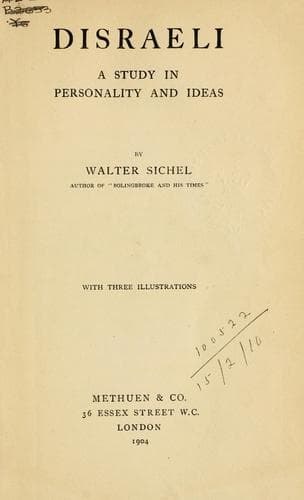
Disraeli: A Study in Personality and IdeasSichel, Walter
History
Disraeli: A Study in Personality and Ideas
Sichel, Walter
Disraeli, Benjamin, 1804-1881
To cherish national unison as a higher form of human harmony than
the discordant bond of automatic groups; to force the governing to
sympathise with the governed; to establish that “Labour requires
regulation as much as Property;” to raise, train, improve and establish
labour “rather,” as he wrote in 1870, “by the use of ancient forms and
the restoration of the past than by political revolutions founded on
abstract ideas,” were Disraeli’s aims. In all except the important one
of the last, the means for accomplishing them, Carlyle’s message is the
same. There is a passage in _Coningsby_ where Disraeli dreams that a
day may come when industry will cease to obey mere industrialism. There
is another in Carlyle’s “Past and Present”[78] to the same effect.
For both, the nobility of labour was a central idea; for both, the
conviction that the cavaliers of England should prove its captains; for
both, _Sanitas sanitatum_ was a practical ideal. “Deliver me,” cries
Carlyle, “these rickety perishing souls of infants, and let your cotton
trade take its chance.” Disraeli and Carlyle alike abominated the
doctrine that national happiness consists merely in material wealth. A
shared or common wealth of endeavour and influence was a goal for each;
for each, too, the main problem remained, “_How, in conjunction with
inevitable democracy, indispensable sovereignty is to exist._”
“... If there be a change,” said Sybil, “it is because in some degree
the People have learnt their strength.”
“Ah! Dismiss from your mind those fallacious fancies,” said Egremont.
“The People are not strong; the People never can be strong. Their
attempts at self-vindication will end only in their suffering and
confusion. It is civilisation that has effected, that is effecting,
this change. It is that increased knowledge of themselves that teaches
the educated their social duties. _There is a day-spring in the history
of this nation which perhaps those only who are on the mountaintops
can as yet recognise. You deem you are in darkness, and I see a dawn._
The new generation of the aristocracy of England are not tyrants, not
oppressors, Sybil.... Their intelligence, better than that, their
hearts, are open to the responsibility of their situation. But the
work that lies before them is no holiday work. It is not the fever
of superficial impulse that can remove the deep-fixed barriers of
centuries of ignorance and crime. Enough that their sympathies are
awakened; time and thought will bring the rest. They are the natural
leaders of the People, Sybil....”
I may be permitted to point out a likeness and a contrast. The seething
ferment on the Continent was pricking Labour into an insurgent
materialism which, in the dearth of ancient and active institutions
fraught with the balm of healing, leagued itself to attack all forms of
authority, kingship and capital alike.
Public-domain text, read in full here on John Shaqi.
Reviews
Reviews
No reviews yet
Be the first to share your thoughts on this work.
Elsewhere in the archive
Join the Discussion
Join the discussion
Sign in to leave a comment or review.
Sign InorCreate an account