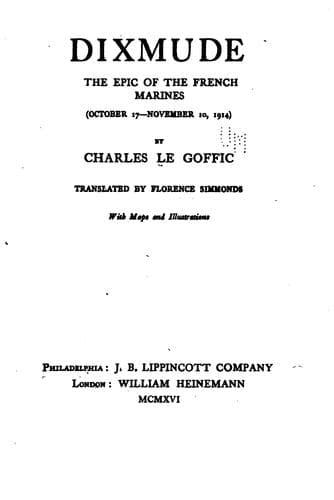
Dixmude: The epic of the French marines (October 17-November 10, 1914) — John Shaqi
Dixmude: The epic of the French marines (October 17-November 10, 1914)Le Goffic, Charles
History
Dixmude: The epic of the French marines (October 17-November 10, 1914)
Le Goffic, Charles
France. Marine. Brigade des fusiliers marins; World War, 1914-1918 -- Campaigns -- Belgium; Yser, Battle of the, Belgium, 1914
By the end of August, indeed, General von Boehn's Army Corps had
advanced to Melle, within a few miles of Ghent. Although no resistance
had been offered, Melle had been partially burnt and pillaged; the
Germans had spared only the distillery where their troops were
quartered, which belonged to a naturalised Bavarian. To save the town
from effective occupation by the enemy, the Burgomaster, M. Braun, had
agreed with General von Boehn to undertake the victualling of the German
troops stationed at Beleghem. The requisition was not a very harsh one
for war time. But the foes were to meet again; on August 25, the morrow
of Charleroi, the Kaiser would have cashiered a general as duly
convicted of imbecility who had ventured to suggest that in October
France, supposing her to be still alive, would have had strength enough
in her death-throes to detach units and send them to the help of
Belgium. Be this as it may, it is certain that the Belgian army owed its
salvation to this erroneous calculation, or foolish presumption.
The effort the enemy had scorned to make in August against Ghent and
West Flanders was now determined upon in October, after the fall of
Antwerp. The conditions seemed to have changed but little. Ghent, an
open town, spread over an alluvial plain at the confluence of the
Scheldt and the Lys, which branch off here into innumerable canals, is
open on every side to sudden assault. It has neither forts nor
ramparts. We could only rely upon improvised defences to check the
advance of the enemy. The garrison, under the command of General
Clothen, was reduced to eight squadrons of cavalry, a mixed brigade, a
volunteer brigade, and two line regiments, none of them up to full
strength. However, with our 6,000 rifles, they would suffice to deploy
in the loop of the Scheldt, and on the space between the Scheldt and the
Lys to the south of the town, which seemed to be specially threatened.
If the English 7th Division arrived in time on the following day, it
would reinforce the front, which it would be unnecessary to extend
further for the purposes of a purely temporary defence, designed to give
the army in Antwerp an additional day or two. The fighting would
probably be very severe; neither General Pau, who was responsible for
the plan, nor Admiral Ronarc'h, who was to direct the principal effort,
had any illusions on this score.
"Salute these gentlemen," said the General to his Staff, pointing to
the naval officers; "you will not see them again."[8]
The rest of the brigade followed hard upon the Admiral. The last trains
arrived at Ghent during the night. The whole population was astir,
cheering the sailors as they marched through the town to their
respective barracks: the Léopold Barracks, the Circus, and the Théâtre
Flamand. The officers and the Admiral were lodged at the Hôtel des
Postes.[9] The reveillé was sounded at 4.30 a.m. The men drank their
coffee and set off for Melle, where the Belgians had prepared trenches
for them.
Public-domain text, read in full here on John Shaqi.
Reviews
Reviews
No reviews yet
Be the first to share your thoughts on this work.
Join the Discussion
Join the discussion
Sign in to leave a comment or review.
Sign InorCreate an account