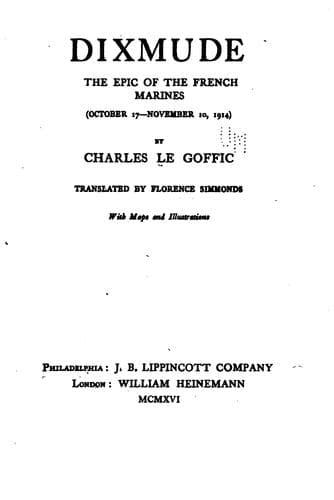
Dixmude: The epic of the French marines (October 17-November 10, 1914)Le Goffic, Charles
History
Dixmude: The epic of the French marines (October 17-November 10, 1914)
Le Goffic, Charles
France. Marine. Brigade des fusiliers marins; World War, 1914-1918 -- Campaigns -- Belgium; Yser, Battle of the, Belgium, 1914
who accepted it thankfully." The mist lifted, but it was still very
dark. Black night on every hand, save down by Quatrecht, where two
torches were blazing, two farms that had been fired. The men listened,
straining their ears. It was just a watch, on land instead of at sea.
But nothing stirred till 9 o'clock. Then suddenly the veil was rent:
shells with luminous fuses burst a few yards from the trenches; the
enemy had received artillery reinforcements; our position was soon to
become untenable. "We saw the Boches by the light of the shells,
creeping along the hedges and houses like rats. We fired into the mass,
and brought them down in heaps, but they kept on advancing. The
Commander was unwilling for us to expose ourselves further; he gave
orders to abandon Gontrode and fall back a little further upon Melle,
behind the railway bank."[12]
We lost a few men in the retreat. But our position was excellent.
About 60 metres from the trenches our machine-guns poured out hell-fire
on the enemy, whom we had allowed to approach. A splendid charge by the
Fusiliers completed his discomfiture. It was four in the morning. At 7
a.m. our patrols brought us word that Gontrode and Quatrecht were
evacuated; the Germans had not even stopped to pick up their wounded.
The Fusiliers did this good office for them when they went to reoccupy
Gontrode, taking the opportunity to collect a good number of German
helmets.[13] Meanwhile the brigade had passed under the command of
General Capper, of the 7th English Division, who had just arrived at
Ghent, where his men received an ovation like that bestowed on our own
sailors. Indeed, there is a strong likeness between them. The Englishmen
in their dark dun-coloured uniform, with their clear eyes and rhythmic
gait, are also of an ocean race, and do not forget it. They swung along,
their rifles under their arms, or held by the barrel against their
shoulders like oars, singing the popular air adopted by the whole
British army:
_It's a long, long way to Tipperary._
Apparently Ghent lies on the road to this goal, for the _Tommies_ can
never have been gayer. These fine troops, which advanced to the firing
line as if they had been going to a Thames regatta, were the admiration
not only of the citizens of Ghent, but of our own sailors, who felt an
unexpected tenderness for them. Had not the hereditary foe become our
staunchest ally? "We look upon them as brothers," wrote a sailor of the
Passage Lauriec to his family next day.
Public-domain text, read in full here on John Shaqi.
Reviews
Reviews
No reviews yet
Be the first to share your thoughts on this work.
Join the Discussion
Join the discussion
Sign in to leave a comment or review.
Sign InorCreate an account