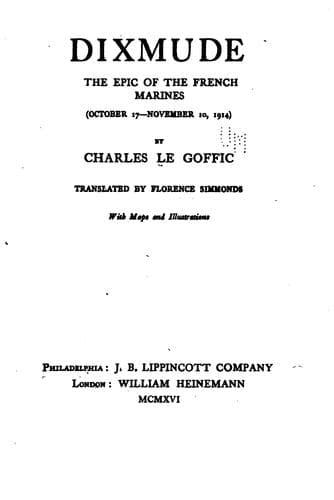
Dixmude: The epic of the French marines (October 17-November 10, 1914)Le Goffic, Charles
History
Dixmude: The epic of the French marines (October 17-November 10, 1914)
Le Goffic, Charles
France. Marine. Brigade des fusiliers marins; World War, 1914-1918 -- Campaigns -- Belgium; Yser, Battle of the, Belgium, 1914
Such were the only battles that they knew; no invader had ever ventured
among them. Invasion, indeed, seemed physically impossible. The whole
country between the hills of Cassel, Dixmude, and the line of sand-hills
along the coast is but a vast _schoore_, a huge polder snatched from
the sea, and almost entirely below the sea-level, owing to the deposits
of mud left high and dry on the shore. Down to the eleventh century it
was still a bay into which the _drakkars_ of the Norse pirates might
venture. If Dixmude, like Penmarc'h and Pont-Labbé, had retained its
maritime character, we might have found on the fronts of its riverside
houses the rusty iron rings to which barques were once moored. To
safeguard the tenure of this uncertain soil, slowly annexed by centuries
of effort, conquered, but not subdued, and always ready to revert to its
former state, it was not enough to thrust back the sea, which would have
overflowed it twice a day at high tide; it was further necessary to
drain off the fresh water, which streams down into it from the west and
the south, mainly from the stiff clay of the Dutch hills, floods the
meadows, cuts through the roads, and invades the villages. The struggle
is unintermittent. Such country, threatened on every side, is only
habitable by virtue of incessant precautions and watchfulness. The sea
is kept under control by Nieuport, with its formidable array of sluices,
locks, chambers, water-gates, and cranks; the fresh water, which oozes
out on every hand, spangling the rough homespun of the glebe with
diamond pools from the beginning of autumn to long after the end of
winter, is dealt with by a methodical and untiring system of drainage
directed, under State control, by associations of farmers and landowners
(_gardes wateringues_). Hence the innumerable cuttings (_watergands_)
along the hedges, the thousands of drains that chequer the soil, the
dykes, several metres high, which overhang the rivers--the Yser, the
Yperlee, the Kemmelbeck, the Berteartaart, the Vliet, and twenty other
unnamed streams of inoffensive aspect--which, when swelled by the autumn
rains, become foaming torrents rushing out upon the ancient _schoore_ of
Dixmude. The roads have to be raised very high in this boundless marsh
land, the depressed surface of which is broken only by sparse groups of
trees and the roofs of low-lying farms. They are few in number, only
just sufficient to ensure communication, and they require constant
repair. Torn up by shells and mined by the huge German explosives, the
"saucepans" (_marmites_) and "big niggers" (_gros noirs_), as the
sailors call them, our company of French and Belgian road-menders had to
work day and night throughout the operations to keep them open.
Public-domain text, read in full here on John Shaqi.
Reviews
Reviews
No reviews yet
Be the first to share your thoughts on this work.
Join the Discussion
Join the discussion
Sign in to leave a comment or review.
Sign InorCreate an account