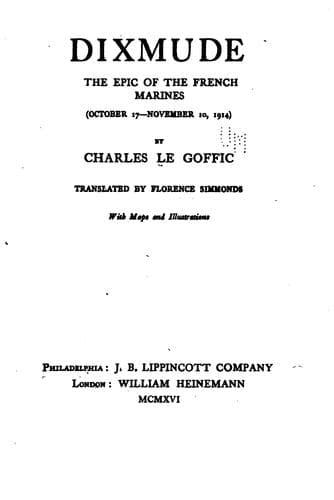
Dixmude: The epic of the French marines (October 17-November 10, 1914)Le Goffic, Charles
History
Dixmude: The epic of the French marines (October 17-November 10, 1914)
Le Goffic, Charles
France. Marine. Brigade des fusiliers marins; World War, 1914-1918 -- Campaigns -- Belgium; Yser, Battle of the, Belgium, 1914
The enemy had begun in his customary manner by preparing the ground with
his artillery, which from the hollow where it was posted, near Eessen,
to the east of Dixmude, rained projectiles upon us from 10 and
15-centimetre guns. Scarcely had the last smoke clouds of the German
batteries lifted, when the infantry advanced to the attack. The action
was very hot, and was prolonged throughout the night and the morning of
the 17th, with violent alternations of advance and retreat. The enemy,
anxious to deal a decisive blow, came on in compact masses, in which
our machine-guns and rifle fire tore bloody breaches. These mobile
bastions wavered for a few seconds, filled up the breaches, and then
returned to the charge in the same close formation as before. No network
of barbed wire protected the approach to our trenches; most of them had
neither roofs nor parapets. In these haphazard defences, successful
resistance depended solely on the intrepidity of the men and the skill
of the commander. Certain "elements" were taken, retaken, lost, and
retaken again. But as a whole our line held; the enemy failed to break
through it. At dawn, discouraged, he suspended his attack, but, like a
dog who makes off growling, he never ceased shelling us till 11 a.m.
"After this," notes Fusilier B., "all noise ceased. Dixmude has not
suffered much. The damage caused by the shells is insignificant." True,
the enemy had not yet received his heavy artillery.
We profited by the respite granted us to repair the trenches of the
outskirts, which were somewhat damaged, and begin the organisation of
the others. This work, indeed, was resumed whenever there was a lull,
but it was carried on chiefly at night, and in the morning, from 5 to 9
o'clock, until the mists lifted. At this hour and the coming of light
the German batteries generally awoke. We had not enough guns to reply
efficaciously to the enemy. The brigade was therefore greatly rejoiced
by the reinforcements it received during the day of the 17th: five
batteries of the 3rd Regiment of Belgian Artillery (Colonel de
Weeschouwer), which, added to the Pontus group, gave the defenders of
Dixmude the respectable total of 72 guns. Unhappily their range was not
very great, and the metal of which they were made was not strong enough
to bear the strain of our .75 shells. Such as they were, however, our
front was in much better case when they had been distributed from
Caeskerke to Saint-Jacques-Cappelle. The Admiral, who wished to direct
their operations himself, had these batteries connected by telephone
with his quarters; a battle is directed from a study-table nowadays.
Nevertheless, he gave a standing order that the batteries were to open
fire instantly, whether by day or night, on the approaches to Dixmude,
whenever rifle fire or the sound of machine-guns indicated that an
infantry attack threatened our trenches.
Public-domain text, read in full here on John Shaqi.
Reviews
Reviews
No reviews yet
Be the first to share your thoughts on this work.
Join the Discussion
Join the discussion
Sign in to leave a comment or review.
Sign InorCreate an account