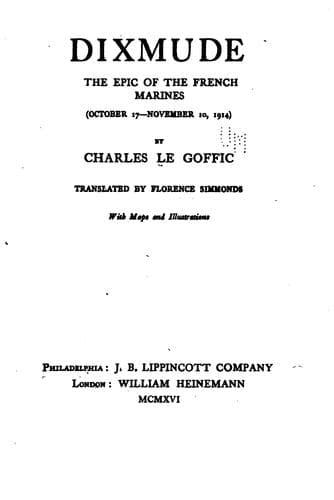
Dixmude: The epic of the French marines (October 17-November 10, 1914)Le Goffic, Charles
History
Dixmude: The epic of the French marines (October 17-November 10, 1914)
Le Goffic, Charles
France. Marine. Brigade des fusiliers marins; World War, 1914-1918 -- Campaigns -- Belgium; Yser, Battle of the, Belgium, 1914
"And smiling to encourage his men," added the eye-witness who reported
this dialogue, "he went off to a post as exposed as a glacis."
With such officers, Dixmude was better defended than if it had had a
triple line of blockhouses. The men, who were worthy of their leaders,
had soon grown used to the racket of the shells. The damage they do is
not in proportion to the noise they make, "for one can see them coming,
and they are heralded by a creaking sound, as of ungreased pulleys,"[37]
wrote a Marine to his family, adding ingenuously: "All the same, anyone
who wants to hear guns has only to come here." Indeed, the noise was
stupendous: 420, 305, and 77 were thundering in unison. As we had no
heavy artillery to reply, we had to wait patiently for the inevitable
attack which follows after the ground is cleared. Then the 72-m. guns of
our six groups would be able to have their say. Unfortunately on our
right the ravages caused in the Belgian trenches by the storm of German
artillery had made it impossible for our allies to hold their position;
this being duly notified in time, the Admiral sent four of our companies
to replace them. Scarcely were they installed, when the German attack
began. Sure of themselves and of victory, they had adopted the close
formation of their first onslaught, with machine-guns in the rear, the
veterans on the two wings, the conscripts in the centre and in front,
the latter with rapt, ecstatic faces, the former swelling with the pride
of former victories, all united by the same patriotic ideal, marching
rhythmically, and singing hymns to the national God. The majority were
young men, hardly more than boys. Later, in the trenches, when the
Marines fell upon them, they knelt down, clasping their hands, weeping,
and begging for quarter. But here, in the excitement of the _mêlée_,
elbow to elbow and sixteen ranks deep, they had but one colossal and
ferocious soul. They were swinging along with a slightly undulating
movement when the fire of our machine-guns struck them, true sons of
those other barbarians who linked themselves together with chains, that
they might form a solid block in death or in victory. An aroma of
alcohol, ether, and murder preceded them, as it had been the breath of
the blood-stained machine. Our men allowed them to approach within a
hundred yards. To the shouts of _Vorwärts!_ ("Forward!") from the
enemy's ranks we answered abruptly by the orders "Independent fire!
Continuous fire!" given by officers and petty officers. Behind their
parapets, amidst the buzz of bullets and the bursting of shrapnel, the
Marines did not miss a single shot. "We'll do for you!" yelled the
gunners, catching the contagious fever of battle. The Germans came on
steadily, but the mass was no longer solid. The dislocated machine was
working with difficulty. It uttered its death-rattle at the foot of the
trenches in the network of barbed wire where the survivors had rolled
over.
Public-domain text, read in full here on John Shaqi.
Reviews
Reviews
No reviews yet
Be the first to share your thoughts on this work.
Join the Discussion
Join the discussion
Sign in to leave a comment or review.
Sign InorCreate an account