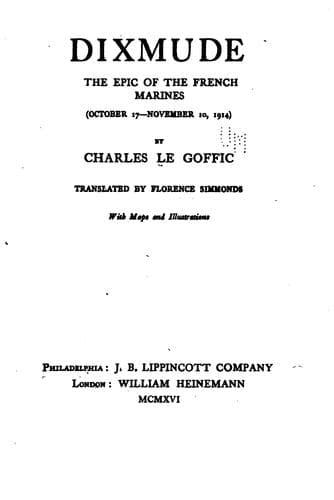
Dixmude: The epic of the French marines (October 17-November 10, 1914)Le Goffic, Charles
History
Dixmude: The epic of the French marines (October 17-November 10, 1914)
Le Goffic, Charles
France. Marine. Brigade des fusiliers marins; World War, 1914-1918 -- Campaigns -- Belgium; Yser, Battle of the, Belgium, 1914
[55] This story is told by the Marine Georges Delaballe. Such was the
ardour communicated by Des Pallières to his men, that the next day a
Marine and a Boche were found "lying dead one upon the other, the
Marine's fingers thrust through the German's cheek, and still clutching
it." A stray bullet had killed them both. What had exasperated the
Marines was that the major who led the attack wore a large Red Cross
armlet. Their native honesty was revolted by this constant recourse to
ignoble ruses, by which our enemies have dishonoured even their own
heroism. Martin des Pallières was the nephew of the Admiral who
commanded the Marines in 1870. "He was a brave man, whose courage was
combined with great simplicity and gaiety. He was killed by a big shell
in the middle of the group of machine-guns he was working under a
furious fire," writes a correspondent. Dr. Caradec points out that this
night of October 26 was particularly tragic; and in support of this
statement he quotes an incident horrible enough, indeed, from the
narrative of the naval mechanician Le L.:--
"The Germans had taken some French trenches, and shells were raining
thickly upon us. All of a sudden some of our men were engulfed in a mass
of _débris_. As one of my friends was half buried in the earth, I and
another went to help him; but a shell fell right upon him, and I in my
turn was buried up to the neck. Night was coming on fast. I spent
fourteen hours of anguish in this position. Furious fighting was going
on. Two friends were moaning near me. The one nearest begged me to help
him, but I was held fast as in a vice, and had to look on helpless as he
died. My own strength began to fail. I became unconscious a few hours
after I had been buried. What made me suffer most was to see the Germans
a few yards from me. I could see all they were doing, all their
death-dealing preparations. During the night the Senegalese riflemen
retook our lost trenches; they set to work to clear away the rubbish and
found my two dead friends near me. One of the Senegalese stepped on my
head. Feeling something under his feet, he bent down and saw me. They
got me out and took me to the first ambulance. In a few hours I was
fully conscious again. You can imagine how I rejoiced to find myself
among friends. I felt like one risen from the dead."
Public-domain text, read in full here on John Shaqi.
Reviews
Reviews
No reviews yet
Be the first to share your thoughts on this work.
Elsewhere in the archive
Join the Discussion
Join the discussion
Sign in to leave a comment or review.
Sign InorCreate an account