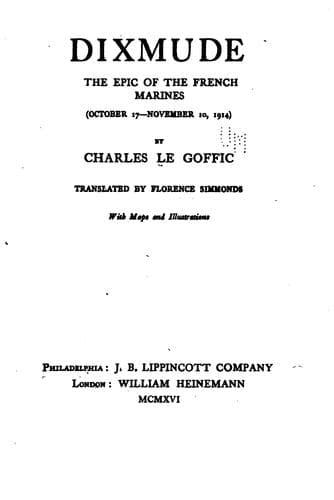
Dixmude: The epic of the French marines (October 17-November 10, 1914)Le Goffic, Charles
History
Dixmude: The epic of the French marines (October 17-November 10, 1914)
Le Goffic, Charles
France. Marine. Brigade des fusiliers marins; World War, 1914-1918 -- Campaigns -- Belgium; Yser, Battle of the, Belgium, 1914
[56] Among them was Second-Lieutenant Gautier. The following order,
communicated to us by his family, was found with his papers: "Monsieur
Gautier,--By superior orders, I am sending a section to relieve you, and
to instruct you to go with your section near the cemetery, behind the
wall or on the railway embankment, as may seem best to you and to the
officer in the adjoining trenches. Des Pallières' section, which was in
the cemetery, has been annihilated, Des Pallières himself killed and
buried in the _débris_ of the trench." Second-Lieutenant Gautier was
killed at 9 o'clock in the evening. "We were having our dinner in the
trench," wrote Lieutenant Gamas a few days later, "when the order came
for him to go to a dangerous position to replace Des Pallières, who had
just been killed there. The last words your son-in-law said to me were:
'Captain, it's my turn.' We shook hands warmly, looking affectionately
at each other. The next day I heard that my poor friend was dead. He had
been hit in the forehead by a German bullet at the moment when, attacked
by very superior numbers with three machine-gun sections, he had put his
head out in order to regulate his fire and do his duty thoroughly. He
fell nobly, leaving a glorious and honoured name to his wife and
children."
[57] All the officers we have seen or who have written to us declare
that the transport service was excellent throughout the defence, in
spite of the greatest difficulties, and that the naval commissariat was
irreproachable.
[58] He was decorated with the military medal by General Foch in person.
XI. THE ATTACK ON THE CHÂTEAU DE WOUMEN
All Saints' Day was nearly as quiet as the preceding forty-eight hours.
We re-established our trenches, and the Admiral reorganised his
regiments and transferred his headquarters to Oudecappelle. In his
journal Alfred de Nanteuil, who had been with our second line from the
day before, notices the truce from _marmites_, if not from shrapnel and
bullets, "singing past a little like summer flies." But farms were
blazing all round the vast horizon, lighting up the November night and
accentuating the fact that, although the enemy's attentions had changed
in form, they had put on no amenity. "One of my men," says De Nanteuil,
"found the severed hand of a small child in a German's knapsack...." And
at Eessen, where the _vicaire_ was a young priest of twenty-eight, the
Abbé Deman, his murderers amused themselves by forcing him to dig his
own grave before they shot him in the graveyard of his own church.[59]
Public-domain text, read in full here on John Shaqi.
Reviews
Reviews
No reviews yet
Be the first to share your thoughts on this work.
Elsewhere in the archive
Join the Discussion
Join the discussion
Sign in to leave a comment or review.
Sign InorCreate an account