Woman’s Exchanges, articles offered for sale at, better but more
expensive, 213;
high standard for work maintained by, 217;
management of, should be put on business basis, 217;
new occupation for women opened by, 218.
Women, as affected by the release of labor from the home through
introduction of factory system, 10-13;
number of, in manufacturing industries, 10, n.;
new opportunities for, about 1830, 12;
unwillingness of many to work for remuneration, a hindrance, 14,
202, 272;
progress of, hindered by their failure to put a just money value on
their services, 14;
foreign born wage-earning, majority of, domestic employees, 77;
wages of, in domestic service lower than wages of men, 92;
entrance of, into business occupations, 196;
can engage in many more occupations than formerly without social
ostracism, 205;
new occupation opened through Woman’s Exchange, 218;
new opportunities through specialization of household employments,
226, 227, 232;
their release from certain kinds of work through specialization of
household employments, 231;
opportunity thus opened to specialize in some branch of work on a
business basis, 231, 232;
conservatism of many, a hindrance to improvement in domestic
service, 264, 265;
tendency of many toward aristocracy, a hindrance to improvement,
265;
work of, needs readjustment, 270-273.
Work, standard of, improved by requirements of Woman’s Exchanges,
217, 218.
“Working housekeeper,” as substitute for “servant,” 156.
World’s Fair, 1893, efforts in connection with, to establish national
training schools for domestic employees, 181.
Wright, Mr. Carroll D., on agencies producing change from domestic to
factory system, 8;
on profit sharing, 236, 237, 240.
Zimmern, Alice, on domestic service in America, 275, n.
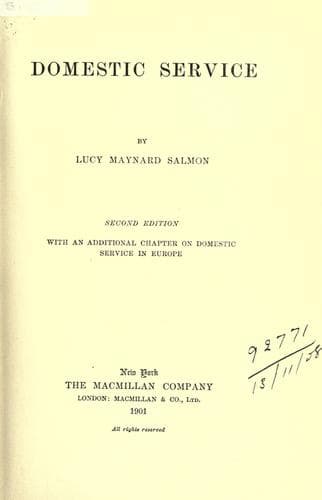
DOMESTIC SERVICE
BY
LUCY MAYNARD SALMON
Press Comments on the First Edition
“This is an admirable analysis of the difficulties, advantages, and
disadvantages of domestic service, with illustrations and statistics
drawn from a careful investigation by the author and from government
reports. The book should be carefully studied by all who believe that the
family is the primary agency for social reform and progress, and that
public health and happiness wait for the advancement of the industrial
methods.”—_The Dial_ (Chicago).
“Lucy Maynard Salmon has made a scientific, and we think a thorough,
study of the perplexing problem so often called ‘the servant question.’
The result is more than satisfactory, and if her book ‘Domestic Service’
is read as widely as it deserves to be read, there ought to be, in the
near future, a far greater number of happy housekeepers and contented
servants than exist at present.”—_Mail and Express_ (New York).
Public-domain text, read in full here on John Shaqi.
Reviews
Reviews
No reviews yet
Be the first to share your thoughts on this work.
Elsewhere in the archive
Join the Discussion
Join the discussion
Sign in to leave a comment or review.
Sign InorCreate an account