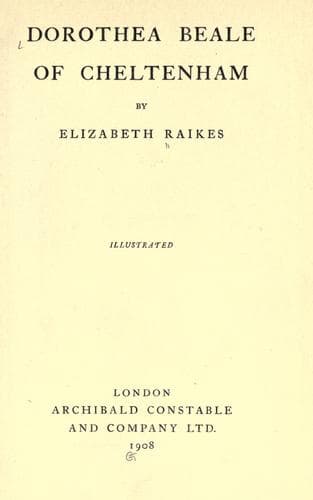
Beale, Dorothea, 1831-1906; Cheltenham Ladies' College -- History; Teachers -- England -- Biography
Mrs. Grey’s conclusions were the same as those of the Commissioners,
who complained that there was no demand for the education of girls, the
cause of the indifference being that low idea which regards only the
money value of education, and estimates it solely as a means of getting
on. Girls were taught with a view to increasing their attractiveness
before marriage, rather than with that of increasing their happiness and
usefulness after. This was the general cause of dissatisfaction, but
there were many details.
One and all complained that, with the exception of quite a few schools,
the education of girls in the middle classes was much worse than that
existing in the elementary schools of the day. This was of course
specially the case in subjects like arithmetic, and arose greatly from
the mistaken notion that they were of no use to girls. The Commissioners
were unanimous in condemning the prevailing method of instruction by
means of such books as _Mangnall’s Questions_ and the like, termed by
Mr. Bryce ‘the noxious brood of catechisms.’ Of this, be it said, Miss
Mangnall’s famous work, which bears witness to its author’s well-stored
mind, and which reached nearly a hundred editions, was the best. The
‘Questions’ demanded indeed the knowledge of such useless facts as the
number of houses burned in the Great Fire of London; but there were in
use, in the numerous small private schools of the period, cheaper and
more stupid books, in which the information was not merely useless,
but even defied common sense. A small catechism on ‘Science,’ entitled
‘Why and Because,’ concluded a long list of inept questions with:
‘Why do pensioners and aged cottagers put their teapots on the hob to
draw?’ In some books, facts of varying nature—of history, geography,
grammar, etc.—were all jumbled together. It is not surprising that girls
instructed by the parrot-like, inconsequent methods of such lesson-books,
passed from school with no love of reading.
The Commissioners complained further, that though French and music were
held to be the most important subjects to which a girl should devote
herself, they were nearly always very badly taught. They spoke of time
wasted at the piano; they calculated the thousands of hours given to
music which was not worth hearing at the last. They gave instances of
ludicrous mistakes in French, which no effort of visiting masters could
improve into anything like a real knowledge of the language, because
rudimentary grammar had never been mastered. They spoke of drawing taught
with an equal disregard of thoroughness, and with still more disastrous
result. ‘The common practice of masters touching up their pupils’
performances for exhibition at home fosters a habit of dishonesty,
and that too prevalent tendency running through the whole of female
education, the tendency to care more for appearance than reality, to seem
rather than to be.’[43]
Public-domain text, read in full here on John Shaqi.
Reviews
Reviews
No reviews yet
Be the first to share your thoughts on this work.
Elsewhere in the archive
Join the Discussion
Join the discussion
Sign in to leave a comment or review.
Sign InorCreate an account