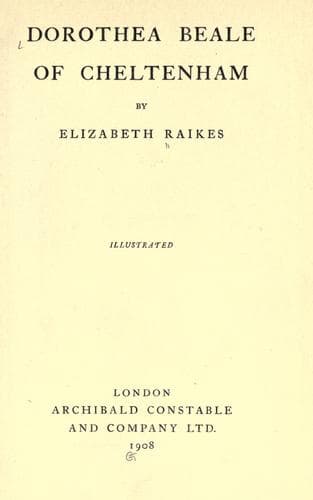
Beale, Dorothea, 1831-1906; Cheltenham Ladies' College -- History; Teachers -- England -- Biography
Some spoke of the absence of healthy interests, of the need for games,
a need which appealed but little to Miss Beale, in whose own youth play
was marked by its absence only. Many urged the necessity for founding in
every town public schools similar to boys’ grammar schools, where girls
could obtain a sound education, without accomplishments, at a low cost.
These reports embody a number of facts concerning a state of things
now happily passed away. Hundreds of small private schools might have
read their doom in them, for the establishment of many public schools,
endowed and otherwise, soon followed the inquiry. We see the poor sham
education, with its wrong notions of the beautiful and the best, vanish
without a regret. Yet, since all human effort has its worth and place,
is it possible and fair to say one word above its grave? Was there no
genuine wish to give pleasure pleading in the miserable pieces of the
boarding-school young lady, and even in the painful drawings which
the master’s touch failed to make tolerable? They testify at least to
something out of the work-a-day sphere, to the desire for the ‘something
afar,’ often the first step to a truer vision. Precious years of girlhood
spent on the vain effort to attain accomplishments speak of some dim
perception of the refinement and uplifting which men look for in women.
Ill-devised, badly attempted, poorly carried out, the thought of giving
delight was not only mercenary in aim; behind it was some consciousness
of a real human need. The educators of women to-day should know better
than to despise its pleading, however imperfectly expressed. ‘May I not
have _one_ ornamental one?’ said a brother when a third sister was about
to devote herself to obtaining certificates for mathematics.
Nine ladies, including Miss Emily Davies, Miss Buss, and Miss Beale,
were asked to give evidence before the Commission. Miss Beale’s, which
was taken in 1865, is of double interest, at once touching the state of
girls’ education in general, and the advance being made in the Ladies’
College, Cheltenham. She took with her a hundred entrance examination
papers arranged in order for inspection. Actuated perhaps by the
marvellous carefulness which lost nothing, and seeing a use even in what
would often be considered waste papers, as well as by the definite aim of
preserving a record of progress, she had kept all the answers written by
her pupils to entrance examination questions. With the College papers,
she showed also some written by children in one of the national schools
at Cheltenham, in order that the Commissioners might make a comparison
for themselves.
Public-domain text, read in full here on John Shaqi.
Reviews
Reviews
No reviews yet
Be the first to share your thoughts on this work.
Elsewhere in the archive
Join the Discussion
Join the discussion
Sign in to leave a comment or review.
Sign InorCreate an account