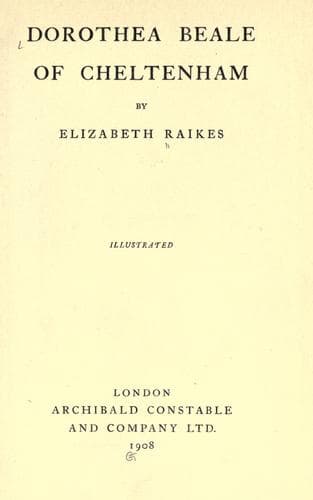
Beale, Dorothea, 1831-1906; Cheltenham Ladies' College -- History; Teachers -- England -- Biography
On being questioned, Miss Beale explained in detail the whole system of
the College, interesting the Commissioners in the method of teaching
Euclid, one which at some points antedated by many years the present
teaching of geometry in the public schools, and which has lately been
adopted by the universities. At a time when schoolboys were learning
Euclid by heart, Miss Beale was teaching it to girls by a method of
explanation which they had to follow and finally reproduce without any
learning by rote.
With regard to the teaching of Holy Scripture she said, ‘Each class
teacher takes her own class, and that, I think, very important’; but on
this subject little was said.
On the question of discipline and moral difficulties she explained that
the government of the College was chiefly by personal influence, and that
her plan was to make use of very simple means, such as changing the seat
of a child who was suspected of being dishonest in her work. ‘It is a
small thing, but it indicates want of trust, and it is by small things we
govern.’ Such discipline obviously appeared slight to Dr. Storrar, who
asked on hearing it, ‘Perhaps girls are more sensitive than boys in such
matters?’ ‘I will not attempt to decide,’ replied Miss Beale, ‘but my
opinion is that they are not.’
Asked her opinion on a system of examination, Miss Beale recommended
a general Board for the examination of teachers, to be founded with
national sanction, and an inspection of the schools under the management
of those who had passed the examination. ‘There is one other point,’ she
added: ‘the cause might be helped on by the establishment of a model
school for the training of teachers; I hardly know how such would work.’
The evidence of the Commission, published in 1868, produced a great
impression on Mrs. William Grey and her sister, Miss Shireff. Under
their able leadership there was formed, in 1871, ‘The National Union
for Improving the Education of Women,’ for the purpose of organising
effort and helping to create a sounder public opinion with regard to
education itself. The work of this society led two years later to the
foundation of the Girls’ Public Day-School Company. By this agency, which
was commercial as well as educational, High Schools were established
in most of the important towns of England. There followed the numerous
independent efforts and companies which have covered the country with
a network of secondary schools for girls. In 1872, Miss Buss giving
up her private property in her very successful school, by an act of
self-sacrifice and generosity made it a public school by placing it in
trust. A lower school was also established in Camden Town under the same
management.
Public-domain text, read in full here on John Shaqi.
Reviews
Reviews
No reviews yet
Be the first to share your thoughts on this work.
Elsewhere in the archive
Join the Discussion
Join the discussion
Sign in to leave a comment or review.
Sign InorCreate an account