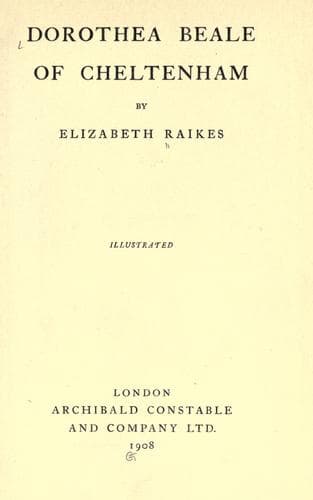
Beale, Dorothea, 1831-1906; Cheltenham Ladies' College -- History; Teachers -- England -- Biography
At first the position of a head of a boarding-house was little defined,
and it was hard sometimes for a clever, well-intentioned woman, anxious
to do the best for the children in her care, not to regard the work of
the house as primary, that of the College as secondary only. One lady,
who was extremely capable and interested in her work, was ambitious to
make her boarding-house a complete institution in itself, rather than an
integral part of the College. Many of the girls in her charge came as
her own relations or friends; she chose to adopt the position that it
was right for her to decide whether they should be taught at her house
or sent to College, and she denied the right of any one to interfere in
her management. She also claimed the right to take another house for
herself and her own children, where she could receive and entertain her
friends. As soon as Miss Beale’s eyes were opened to the danger of such
independent action, she did not hesitate a moment on the right course to
be pursued with regard to the boarding-house management. She perceived
that in this matter, as in the work of the school, there was no standing
ground between obedience and independence. ‘I am so sorry for Miss
Beale,’ wrote Mrs. William Grey to Miss Buss, ‘and so glad our Council
determined to have nothing to do with Boarding-Houses. I cannot help
thinking that the wisest course for the Cheltenham Council would be to
wash their hands of them, only reserving to themselves, as we have, the
right to refuse pupils from a house they disapprove of. There seems to me
no tolerable alternative between this and the hostelry system.’
It may be safely said that never, even in moments of worst annoyance,
did Miss Beale ever propose to ‘wash her hands’ of the boarding-houses.
She felt they should be ‘organically related’ to the College life, a
part of it which she could not do without, one which had in it great
possibilities for extending and strengthening the influence of the
College teaching, one which, neglected, must be an infinite source
of difficulty, by which the standard of the corporate life might be
lowered, and its best work hindered.
So she persisted, lending her whole mind and strength to help in the
evolution of a system which should be fair to individuals and the best
for the College as a body. In 1890, after she had won her point, she
wrote to Miss Arnold, then head-mistress of the Truro High School, who
had consulted her on the subject:—
Public-domain text, read in full here on John Shaqi.
Reviews
Reviews
No reviews yet
Be the first to share your thoughts on this work.
Elsewhere in the archive
Join the Discussion
Join the discussion
Sign in to leave a comment or review.
Sign InorCreate an account