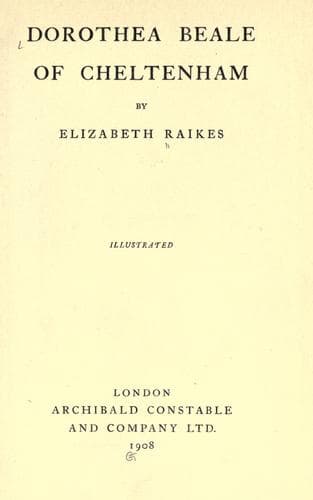
Beale, Dorothea, 1831-1906; Cheltenham Ladies' College -- History; Teachers -- England -- Biography
‘I think I told you that after many years, I have prevailed on
our Council to take the whole risk of the boarding-houses,—the
pecuniary risk is of course very great, and in case of war
or sudden depression, I don’t exactly see how we should meet
it, but one must have risks, and we find the moral risks of
not taking pecuniary ones so great that we decided for the
latter—and indeed we had to pay pretty considerable sums in
law expenses and to get rid of unjust claims too. We could not
_prove_ that these ladies had not lost money, if they said they
had—and if they were bad managers they did perhaps lose—and an
outcry was raised that we ruined poor ladies!’
But the difficulties to be encountered on the way to this consummation
were by no means slight, and involved great personal anxiety and pain. It
was especially hard to her that she should be known by her own pupils to
be in opposition to any who had been set over them. It was hard to feel
that many with their partial knowledge of facts must misunderstand her,
or childishly attribute her actions to commonplace motives of jealousy
and love of power. Some part of these difficulties became fully public
in 1882, when the College was involved in a libel case, and a lawsuit
which was settled by arbitration. Exoneration from all blame followed in
both instances. In the arbitration case the judgment was delivered by
Mr. Justice Charles, and placed in a sealed envelope with the injunction
that either party might open it on payment of £350. The Council did not
think it necessary to pay this money. Eventually those who had brought
the action against the College did so, to find that the judgment had been
pronounced against them on every count. It was a victory for the College
and the Principal, but it had not been achieved without great toil and
suffering on Miss Beale’s part. She dreaded the cross-examination with
all the nervousness of a sensitive nature. Speaking of it afterwards, and
of all it had cost her, she ever associated with the pain the remembrance
of the immense help and sympathy she had received from her friend Mrs.
James Owen, then a member of the Council, and would say, ‘Mrs. Owen
said I should not be scorched in the fire.’ She was also upborne by
the loyalty of her fellow-workers, both teachers and boarding-house
mistresses, who signed a joint expression of their sympathy with her in
her time of anxiety. Miss Buss gave more than words of sympathy, she was
present herself in the arbitration-room when the case was tried. When it
was over she wrote to her friend to this effect: ‘Yesterday I made the
personal acquaintance of Miss ——. I fell in love with her because she is
so intensely loyal to Cheltenham and to “dear Miss Beale.” I think if you
could have heard her talk, unknown to her, you would have felt that the
severe trial you have had to go through was more than compensated for by
the love and loyalty it has called out to you and the College.’
Public-domain text, read in full here on John Shaqi.
Reviews
Reviews
No reviews yet
Be the first to share your thoughts on this work.
Elsewhere in the archive
Join the Discussion
Join the discussion
Sign in to leave a comment or review.
Sign InorCreate an account