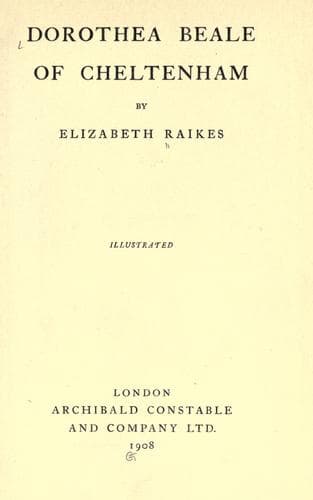
Beale, Dorothea, 1831-1906; Cheltenham Ladies' College -- History; Teachers -- England -- Biography
Cambray School, or, to give it its true title, Cheltenham Ladies’ College
School, and Cambray boarding-house, which took pupils belonging to both
the new school and the College, was not the only undertaking for which
Miss Beale made herself personally responsible. She also started, and
placed in a good financial position, two cheap boarding-houses, St.
Helen’s and St. Austin’s, and in course of time presented them to the
College. Her position in regard to all these institutions was surely
very unusual, not to say unique. The foundation of a school of over one
hundred pupils, and of houses containing the same number of boarders,
would be a respectable life’s work for many a woman. This work appears
to have been only one of the many occupations Miss Beale found for
the little leisure left her by the cares of the great College and its
ever-multiplying interests.
It was perhaps primarily interest in young teachers which led Miss Beale
to join a movement made in 1897 to induce ladies to take up work in
elementary schools. Miss Beale was present at a large meeting held that
year in Westminster Town Hall, when the need and importance of this work
were set forth in speeches by the Bishop of Stepney,[66] Sir Joshua
Fitch, and others. As a result a Government Training Department was at
once formed at the Ladies’ College, and work began with seven students,
who in the same year were encouraged by addresses from Sir H. E. Oakeley,
H.M.I., and Sir Joshua Fitch. The field of practice for these students
was found in All Saints’ Schools, where there were four departments
all supplied with the best apparatus. Other schools in the town were
also glad at different times to receive these teachers. Miss Beale
became much interested in the work, and proposed to build a practising
school of her own for the elementary department of the College, engaged
a head-mistress, and bought land for building. Then in 1901 came the
regulations for local education committees, which would have put Miss
Beale’s school under local control. She therefore gave up the idea of
building and sold her land. Later regulations made her find it impossible
to continue the elementary work on the lines she wished. The Government
demands proved a fetter to one who felt she should be free to work
towards her ideal. To her mind the real progress of elementary education
in the country depended, not on the ‘introduction of new subjects of
instruction, which must impose new and burdensome labour on teachers
and children. It should be gained by the better training of teachers,
by the adoption of better methods, by a wiser economy of time, and by
showing teachers how to put more knowledge, more skill, more thought,
more love, and more enthusiasm into their work.’ The legislation of
1901 made her feel that ‘My Lords’ did not recognise these principles as
all-important; that they undervalued such an effort as she was making at
Cheltenham; that they were unjust to voluntary schools. She felt as if
Public-domain text, read in full here on John Shaqi.
Reviews
Reviews
No reviews yet
Be the first to share your thoughts on this work.
Elsewhere in the archive
Join the Discussion
Join the discussion
Sign in to leave a comment or review.
Sign InorCreate an account