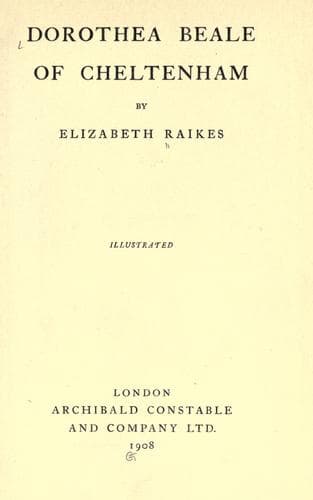
Beale, Dorothea, 1831-1906; Cheltenham Ladies' College -- History; Teachers -- England -- Biography
she were playing an unfair game, and declined any longer to help forward
a movement of which she could not see the goal. It may be marked also
that she could never feel full sympathy for _free_ education. From this
time she again limited herself to training secondary teachers. Conditions
which made elementary training the one serious work which Miss Beale took
up only to abandon it, are indeed to be regretted. The magnificent plant,
the fine opportunities for learning and practising, such as the Ladies’
College could supply, above all the large-minded teaching, the sense of
real education which the Lady Principal would give, were thus lost to a
cause which affects the wellbeing of the whole nation.
The Secondary Training Department became a recognised division of the
College in 1885. So high a value did Miss Beale put upon this that she
wrote of the work of the mistress in whose charge it was, as ‘only second
in importance to that of the Head.’
St. Hilda’s work, using the term which Miss Beale herself would have
used, meant much more than teaching definite subjects and preparing for
examinations: it meant inspiration and the leading out of minds. It
demanded unlimited devotion to a cause. It is probable that Miss Beale
had for long cherished, and had only gradually relinquished a hope,
though she never formed any definite plan, of seeing arise out of her
work for education a body of women willing to form a teaching order.
Opposed to sisterhood schools as she was, chiefly because her ideal of
education was so high and apart, that she could not bear to see it
receive in any way a secondary place, she recognised the immense value
that some kind of rule would have, if voluntarily imposed _for the sake
of education_. In other words, while she did not like to see people
taking up teachers’ work because they were Sisters, she would have liked
to see those she inspired and trained voluntarily take upon themselves
some of the restrictions of a Sister’s life because they were teachers.
The thought may have come to her first when, in 1856 and 1858, Mrs.
Lancaster pressed her to undertake penitentiary work under rule. It
was this which led to the severity of her dress and grave demeanour at
Casterton, this which was echoed in a half-expressed wish that her staff
at Cheltenham should wear black. When, after long years of waiting, it
became her part to train women for the work of education, the aim of
inducing them to adopt a separate devoted life, with or without visible
signs of it, was ever before her.
Now that St. Hilda’s work may be witnessed in the three great
institutions bearing this name, it is of no common interest to trace Miss
Beale’s own plan for its development. The plan itself and the noble ideal
behind it are not more remarkable than the ability with which she waited,
resigned her individual fancy, and became an agent rather than an author.
The following extract (_circa_ 1884) states her first design:—
Public-domain text, read in full here on John Shaqi.
Reviews
Reviews
No reviews yet
Be the first to share your thoughts on this work.
Elsewhere in the archive
Join the Discussion
Join the discussion
Sign in to leave a comment or review.
Sign InorCreate an account