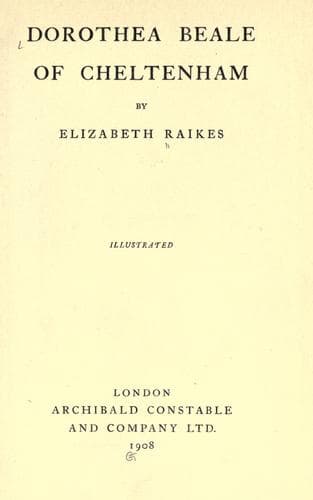
Beale, Dorothea, 1831-1906; Cheltenham Ladies' College -- History; Teachers -- England -- Biography
‘I was much interested in your letter. I feel strongly that
when in God’s Providence we have been trained for one work,
we should not lightly turn to another. As you say, there is
more scope in a large sisterhood. Miss —— is very happy at
Clewer. Still, I think the rules of an ordinary sisterhood are
difficult to combine with the life of a teacher. I cannot help
thinking that out of the Society of the Holy Name may grow up
a somewhat freer teaching sisterhood.... I hold strongly that
there ought to be some women, whose energies should be devoted
to sending out young teachers, with a true sense of their
vocation. You have gifts as a teacher; you ought not, it seems
to me, to bury them....’
Among the women whose saintly lives were a source of inspiration to
Dorothea Beale, there was one whose acquaintance (so to speak) she did
not make until herself in mature life. None the less did the name of Mary
Astell become a thought of encouragement and hope to one whose heart
was ever fresh. When in 1890, after various unsuccessful experiments,
a properly managed house was opened for the regular teachers in the
College, Miss Beale named it Astell House, after the lady who, in the
reign of Anne, put forth ‘a plan of a College for the higher education
of woman, which should be at the same time a religious house. The ladies
were to spend some time in study as well as prayer, Mrs. Astell holding
that they had as much right as men to improve their minds.... Their
special work was to be the education of girls of the higher class, and
also, if their means would admit, of the daughters of poor gentlemen,
who must otherwise remain untaught.... Mrs. Astell’s scheme aroused
considerable interest, and an unnamed lady (supposed to be the Queen)
was ready to give £10,000 for the foundation of such an institution;
but Bishop Burnet, who seems to have been consulted in the matter, put
an end to the plan, saying it would be too much like a nunnery.’ Miss
Beale certainly wanted a nunnery no more than did the timorous Bishop. As
time went on she cared less for the outward shape the spirit she strove
to foster might adopt; but she grew more and more earnest and active in
seeking to influence young teachers to become serious and high-minded
and self-sacrificing. The Quiet Days, which were instituted chiefly to
this end, affected many wholly outside the College. They are therefore
better mentioned in connection with those other interests which, to
borrow her own nomenclature in the Magazine, may be included under the
title of ‘Parerga.’
CHAPTER XII
TEACHER AND PRINCIPAL
‘Languor is not in your heart,
Weakness is not in your word,
Weariness not on your brow.’
M. ARNOLD, ‘Rugby Chapel.’
Public-domain text, read in full here on John Shaqi.
Reviews
Reviews
No reviews yet
Be the first to share your thoughts on this work.
Elsewhere in the archive
Join the Discussion
Join the discussion
Sign in to leave a comment or review.
Sign InorCreate an account