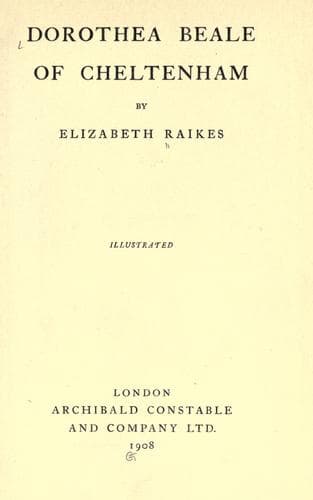
Beale, Dorothea, 1831-1906; Cheltenham Ladies' College -- History; Teachers -- England -- Biography
But if Miss Beale’s methods of teaching history have been to some extent
superseded, it should be remembered that she was among the first to
insist on the importance of general history. Though assured of the value
of detailed and special knowledge, she was not content to let one period
stand alone unlinked with its context. She would not cut off the history
of England as a thing by itself, but showed its place in the stream of
time, in the lives of the nations. So almost every class was obliged to
learn something of outline and general history, and here it was that the
_Chart_ and _Textbook_ played so important a part.
Miss Beale’s English literature lessons may, more than any others she
gave, be described as _sui generis_. ‘Miss Beale gives literature lessons
of a peculiar kind,’ was the appreciation of a new pupil who had studied
the subject before coming to Cheltenham. Her literature lesson, indeed,
had many functions. The subject became the vehicle of much teaching
that it was not convenient to give in a Bible lesson. She sought to
interest her class in books, in reading, in noble thoughts, in fine
prose and poetry. But this was by no means all. She sought primarily
to give views of life, conduct, and character such as would enable her
hearers to go from school into a larger world, already prepared to know
what to find. Under the names of friend and friendship much was said
which might apply equally to the choice of a husband and to marriage.
Knowledge of character, she would often say, is so important for women.
Hence she liked, if possible, once a year to read and lecture upon one
of Shakspere’s great plays to the first class. Though ever fresh and
interesting, and herself as interested as ever in these readings, though
the lectures were constantly brightened and enriched by new books and
thoughts brought to bear upon them, there was very little variation
in the treatment of the main theme. At certain crises in the story,
over certain characters, hearers of long standing knew what to expect.
Ophelia, to take an instance, was for all the generations of girls who
read _Hamlet_ at Cheltenham the woman who failed a man because she
could not dare to be true. A matter like this was vital to Miss Beale.
Could any class-teacher in the College have represented Ophelia in any
other light, the Lady Principal would have spared no pains to point out
the error of the treatment, both to her and to those she had misled.
Desdemona, again, was always marked as the wife who not unnaturally
roused the suspicions of a jealous-minded husband, because he knew that
in marrying him she had deceived her father. The misery that may follow a
secret wilful marriage was always hinted at when this story was told.
Public-domain text, read in full here on John Shaqi.
Reviews
Reviews
No reviews yet
Be the first to share your thoughts on this work.
Elsewhere in the archive
Join the Discussion
Join the discussion
Sign in to leave a comment or review.
Sign InorCreate an account