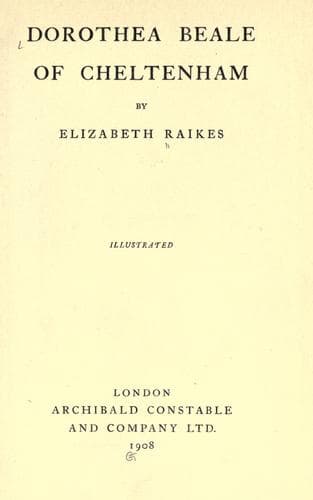
Beale, Dorothea, 1831-1906; Cheltenham Ladies' College -- History; Teachers -- England -- Biography
But there were other and less weighty considerations than influence and
marriage in these lectures. They supplied opportunity for suggestions on
simple affairs such as the choice of books, ways of spending time and
money, manners, conversation, and the like. Often questions of the day,
politics in a very general sense, and social problems were led up to.
Miss Beale might be unacademic to a fault in these lectures, but she
had that power of inspiration which made every poem she prized, every
character she admired, live immortally for those who heard her speak
of them. The actual reading—specially of poetry—was a delight to both
reader and hearers. Miss Beale had a strong dramatic instinct, a keen
enjoyment of poetry and the right use of words. She had also a wonderful
voice, which she managed well, and though always quiet and restrained in
manner carried her audience with her unweariedly. The literature lesson
was long, specially in the early days when, owing to short distances
and small numbers, no time was occupied by arrangements for prayers. For
thirty or forty minutes corrected notes were returned and criticised,
then the lecture proper would begin and go on for a full hour. Sometimes
the whole time, an hour and a half, was taken up by the lecture. It was
certainly very unusual for any one to find it too long.
A further interest in these lectures lay in an effort to make them
language lessons. As a matter of fact, though much interested in language
herself, Miss Beale did little more than inspire a wish to study it
further. Perhaps this was her aim in touching upon it at all. She would
often bring to her lesson a table of Grimm’s Law, explain it very
rapidly, and appear to expect that it should be as rapidly remembered.
Miss Beale’s literature was by no means confined to Shakspere’s plays.
All the greatest and many lesser works in the English tongue were taken
in their turn. But she would seldom take the works of any whose thought
seemed to her inferior; would have little, for instance, to do with
Dryden and Pope. Style in itself had no attraction, and the growth of
literary form, unless accompanied by the development of noble thought,
was of little interest. No subject, perhaps, was more after her own
choice than the poems of Spenser. She would dwell with unfailing delight
on the complicated allegories of the _Faëry Queene_, or on the Hymns to
‘Heavenly Love’ and ‘Heavenly Beauty.’ Nor was a school year ever allowed
to pass without her introducing the higher classes in the College to some
of Browning’s works. How many must have learned to know his greater short
poems by hearing her read them.[70]
Public-domain text, read in full here on John Shaqi.
Reviews
Reviews
No reviews yet
Be the first to share your thoughts on this work.
Elsewhere in the archive
Join the Discussion
Join the discussion
Sign in to leave a comment or review.
Sign InorCreate an account