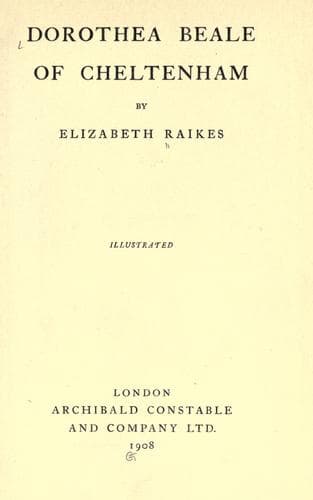
Beale, Dorothea, 1831-1906; Cheltenham Ladies' College -- History; Teachers -- England -- Biography
‘ ... And now what is the main issue before us? When the
Secondary Schools are absorbed into the national system, and
orders are issued to us from the Education Department, shall
we be told that we also are to give only secular instruction,
and forbidden to give definite teaching regarding the creeds
and ritual which express the truths by which we live;—shall
we be forbidden to ask any questions about the fitness of the
teachers whom we wish to appoint? These are matters which seem
to press for answers.
‘Only a few thoughts can I throw out to-day on this subject.
First, it seems inconceivable that there should be any such
limitations of the realms of knowledge as is implied in the
word “secular.” Man’s thoughts cannot be shut in by space or
time, he must seek the real beneath the phenomenal, he must
search for the ultimate; more than any earthly or secular
good he desires to know and live for the things which belong
to an eternal world,—the true, the beautiful, the good.
All literature, all history, attests this. Whence then the
discordant cries, some demanding secular teaching only, others
fearing it?
‘I think we are confused sometimes, because we do not
remember or recognise sufficiently that there are two ways
of approaching the subject of religious teaching and of all
subjects of thought. Take for an illustration the subject now
occupying the scientific world. Can we retain the conception
of the atom as formulated in the last century? Is matter an
aggregate of impenetrable, indivisible nodules, or is an atom
merely a centre of force? Have we nothing that we should call
solid, only vortices? Is solidity a flux of ions? These are
all matters on which the wisest may differ, but there are
certain fundamental facts on which all are agreed—the fact
that there must be one all-embracing medium through which
relations are realised. So in the world of spirit, the fact
is indisputable that we are conscious of forces affecting us
and on which we individually react, indisputable that we can
interpret facts of sensation, and this necessitates a belief
in the correspondence of our mind with one all-embracing
spirit; it seems impossible to doubt that in interpreting
the universe we are corresponding with and holding communion
with an infinite mind revealed in Nature, and we repeat
with inner conviction the first article of our Creed—“God
created,”—we pass on to the second half—“God created man in
His own image,” and so we go on to speak of other articles of
faith. Philosophy, which has so large a place in the Bible
teaching and which is always based on the facts of our inner
consciousness and our moral sense, ought, I believe, to have
a larger space in our teaching, but we should endeavour more
to build on foundations which cannot be shaken. The mystery of
Public-domain text, read in full here on John Shaqi.
Reviews
Reviews
No reviews yet
Be the first to share your thoughts on this work.
Elsewhere in the archive
Join the Discussion
Join the discussion
Sign in to leave a comment or review.
Sign InorCreate an account