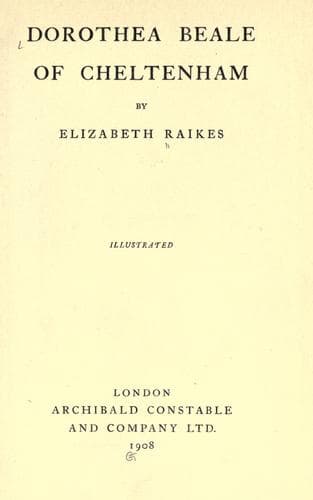
Beale, Dorothea, 1831-1906; Cheltenham Ladies' College -- History; Teachers -- England -- Biography
our own being, the distinction of the “I” and the “Me,” the
facts of conscience, the συνείδησις which lifts us out of the
mere individual or animal, and speaks of the relation of the
true self to the eternal, the kingdom of righteousness,—the
evolution of human thought through the ages,—leads on to the
faith that man is indeed the child of God, that His Spirit is
inspiring us.
‘What seem to us present troubles are perhaps intended to
make us dig deeper in the field wherein the great treasure
of spiritual truth is hidden, so that we may say with fuller
conscious conviction, “The Kingdom of Heaven is at hand”—“is
within you.”’
On her way to Paddington after the Head-mistresses’ Conference, the cab
which contained Miss Beale and Miss Andrews was run into by another, a
shaft shattering the window beside Miss Beale.
She did not realise her danger or that her shawl was full of bits of
broken glass. The accident is alluded to in the letter she afterwards
wrote to Mrs. Woodhouse, whose guest she had been at Clapham.
‘I am so glad I was able to be present. It was a most
interesting meeting; and very glad to see your beautiful
school....
‘Lord Aberdeen [once] complimented me on not suffering from
“train fever”; I am afraid I seemed to do so at lunch. It was
well that we allowed a little spare time to be run into. One
needs to allow for motors!’
It was the year of the Guild meetings. A very large number of old
pupils, larger than ever before, came to Cheltenham in June, for every
year saw additions to the roll of members and no falling off among the
elder ones, who felt each time might be the last occasion on which the
beloved Principal would preside. The subject chosen for the play was the
very unusual one of a story from Egyptian history. No pains were spared
to render it truthfully; Dr. Budge was consulted, the Book of the Dead
studied; Miss Beale herself gave a lecture on the history of Egypt, a
subject she had never worked up before. The story of the great queen
whose life was given up to her country, ordered wholly for their good,
with no private interests; whose marriage was an act of sacrifice; who
ruled her people with large-minded beneficence, and under whom they
prospered; who finally, as age came upon her, resigned for their sake,
seemed strangely appropriate for the close of Miss Beale’s long work for
Cheltenham. The very remoteness of the story, its gravity, the absence
from it of such didacticism as abounded in Miss Beale’s interpretation
of Britomart and Griselda, made it all the more forcible. It was in no
way premeditated. Miss Beale herself said she did not much care for it,
as it contained so little spiritual teaching. But as the curtain fell
upon Hatshepset’s resignation and death, the crowded audiences of past
and present pupils palpably realised that for them the inevitable change
awaiting the College had been, if unconsciously, foreshadowed.
Public-domain text, read in full here on John Shaqi.
Reviews
Reviews
No reviews yet
Be the first to share your thoughts on this work.
Elsewhere in the archive
Join the Discussion
Join the discussion
Sign in to leave a comment or review.
Sign InorCreate an account