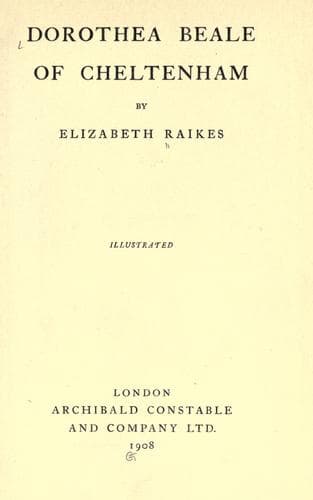
Beale, Dorothea, 1831-1906; Cheltenham Ladies' College -- History; Teachers -- England -- Biography
In after years Miss Caroline Cornwallis moved to Maidstone, where she
exercised her many talents and versatile mind in varied occupations.
Miss Cornwallis not only studied Greek, Latin, and Hebrew, but such
questions of the day as criminal procedure; she also read philosophy.
She wrote besides articles for the _Westminster Review_ and _Fraser’s
Magazine_, several books in a series entitled ‘_Small Books on Great
Subjects_—edited by a few well-wishers to knowledge.’ The first was
_Philosophical Theories and Experience of a Pariah_. She said women were
regarded as pariahs, and were it known that the book was written by a
woman it would not be read.[3] Others of the series which she wrote
were some volumes entitled _A Brief View of Greek Philosophy_, and some
historical works, _The State of the World before the Introduction of
Christianity_. She also wrote a classical novel called _Pericles and
Aspasia_. Miss Cornwallis rejoiced in the fact that as a woman, though
unknown, she obtained for her writings the praise of ‘big-wigs.’
‘“I long,” she wrote to a friend after one of her works had
received flattering notices in the _British Medical Journal_,
“to knock all the big-wigs together and say it was a woman that
did all this—a woman that laughed at you all and despised your
praise. And if, like Caligula’s wish, I could put all mankind
into one and leave you to say that in its ears when I am gone
quietly to my grave, I think it would be glorious. It is as
a woman, and not as the individual C.F.C., that I enjoy my
triumph; for, as regards my own proper self, I like to creep in
a corner and be quiet; but to raise my whole sex and with it
the world is an object worth fagging for. Heart and hand to the
work.”’
[Illustration: _Caroline Frances Cornwallis_
_From a painting by herself_]
Miss Cornwallis reflects the thought of her day with regard to women’s
work. It was one of the tasks of her cousin, Dorothea Beale—whose
‘fagging’ in the next generation did so much for her own sex and the
world—to show that the best work is done when the question of what will
be said about it does not affect it one way or the other.[4]
The authorship of the _Small Books_ was a well-kept secret.
‘We did not know who wrote the books till after her death,
though my aunt, who gave them to us, often stayed with her as
her amanuensis. Miss Cornwallis was a skilled handworker, too.
Before the Society for Home Arts existed she learned to bind
books for her library. She was no mean artist, and her portrait
of herself in her library is considered very successful. I
have heard how she fitted up a marionette theatre for the
amusement of friends. I did not know her personally; she died
when I was young; but the talk of her ability and knowledge,
and the association with my aunt, Elizabeth Complin, who
was her friend, had much to do with calling out my literary
ambition.’[5]
Public-domain text, read in full here on John Shaqi.
Reviews
Reviews
No reviews yet
Be the first to share your thoughts on this work.
Join the Discussion
Join the discussion
Sign in to leave a comment or review.
Sign InorCreate an account