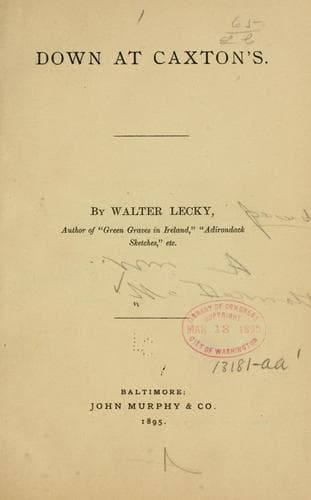
American literature -- 19th century -- History and criticism; American literature -- Catholic authors -- History and criticism
O cloud! press onward to the hill,
He needs you for his falling streams
The sun shall be my solace still
And feed me with his beams.
O little humpback bumble bee!
O smuggler! breaking my repose,
I’ll slily watch you now and see
Where all the honey goes.
Yes, here is room enough for two;
I’d sooner be your friend than not;
Forgetful of the world, as true,
I would it were forgot.”
MAURICE FRANCIS EGAN.
The poet-critic Stedman, in his book on American poetry, gives a few
lines to what he terms the Irish-American school. His definition is a
little misleading, as some of the poets he cites were more American
than the troop of lesser bards that grace his polished pages. It
is rather a strange notion of American critics that Prof. Boyesen,
having cast aside the language of Norseland to sport in the larger
waters of our English tongue, is metamorphosed into a true American,
while the literary sons and daughters of Irish parents, born and
striking root in American soil, are marked with a foreign brand. It
is the old story of English literary prejudice reproduced by American
critics. American _modistes_ go to Paris for their fashions, American
critics to the Strand for their literary canons. It is pleasant to
know that the bulk of the people stay at home. In this Irish-American
school one meets with the name of Maurice Francis Egan. “A sweet and
true poet” is Stedman’s criticism. Coming from a master in the art
of literary interpretation, it must occupy a place in all coming
estimates of Mr. Egan’s poetry. This criticism is, nevertheless,
short and unsatisfactory, it gives no true idea of the poet’s place
in the letters of his country. It merely, if one is inclined to agree
with Stedman, establishes that Mr. Egan has a place among the bards.
In the hall of Parnassus, however, there are so many stalls that the
ordinary reader prefers to have the particular place assigned to each
bard pointed out. The author of this sketch, while not accredited to
the theatre of Parnassus, may be able to give to those who are not
under the guidance of a uniformed usher some hints whereby Mr. Egan’s
particular place may be discerned; that place is among the minor poets.
The major stalls are all empty, waiting for the coming men, so glibly
prophesied about by the little makers of our every-day literature.
Public-domain text, read in full here on John Shaqi.
Reviews
Reviews
No reviews yet
Be the first to share your thoughts on this work.
Join the Discussion
Join the discussion
Sign in to leave a comment or review.
Sign InorCreate an account