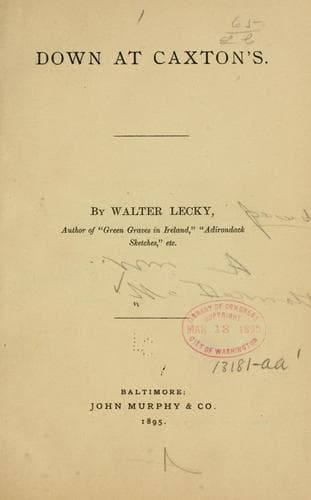
American literature -- 19th century -- History and criticism; American literature -- Catholic authors -- History and criticism
The poet’s first book, a few sonnets and poems, was for “sweet
charity’s sake,” and had but a limited circulation. It is safe to say
that every first book of a genuine poet, despite its crudities, will
show the seeker signs of things to come. Egan’s book was not without
promises, but in truth these promises are only partly fulfilled in his
latest volume of verse. There may be many reasons adduced for this
disparity between promise and fulfilment. One of them is the haste
with which poetry is published. Horace’s dictum of using the file has
been long since forgotten. The rabble calls for poetry, and, like the
Italian and his lentils, care little for the quality. If the poet
harkens to the calls (and who among the contemporary bards has laughed
it to scorn?) he exchanges perpetuity for the present, notoriety for
fame. Nor will the rabble leave the poet freedom in choosing his
material. He is simply a tradesman, and must use what is placed at his
disposal. Things great and grand must be left unto that day when the
poet, untrammelled by worldly care, shall write his heart’s dream. If
the time ever comes, the poet learns in sorrow that his dreams will
never float into human speech, for the hand has lost its cunning. So
the days of youth and manhood pass, blowing bubbles or decorating
platitudes. Death snatches the poetling, and oblivion is his coverlid.
The songs he sang died with the rabble. The new generation asked for
a poet that could drill into the human heart and bring forth its
secrets—a listener to nature, her interpreter to man. To such a one the
vocabulary of a minor bard is useless. Another reason, more applicable
to our author, is that he has been unfortunate to be a pioneer in
Catholic American literature. His poems, appealing, as they do, to
a distinct class, and that far from being a book-buying one, will
fail to attract the lynx-eyed critic who cares only for the general
literary purveyor. From such a source, the poet’s chance of corrective
criticism has been slight. The class to which Mr. Egan belongs has
no criticism to offer its literary food givers. If an author’s book
sells, his name is blazoned forth in half a hundred headless petty
journals. His most glaring defects become through their glasses mystic
beauty spots. He is invited to lecture on all kinds of subjects. A
clique grows around him, whose duty it is to puff the master. The
reasons, frankly adduced, have limited the scope and dwarfed the really
fine genius of Maurice Egan. His latest volume, while containing many
poems that reveal hidden powers, has much of the crudity and faults of
earlier work. These poems speak of better things that will be fulfilled
by the poet if he will consecrate himself wholly to his art, shutting
his mind to the rabble shout and eulogious criticism. Then may he hear
the rhythms and cadences of that music whose orchestra comprises all
things from the shells to the stars, all beings from the worm to man,
Public-domain text, read in full here on John Shaqi.
Reviews
Reviews
No reviews yet
Be the first to share your thoughts on this work.
Join the Discussion
Join the discussion
Sign in to leave a comment or review.
Sign InorCreate an account