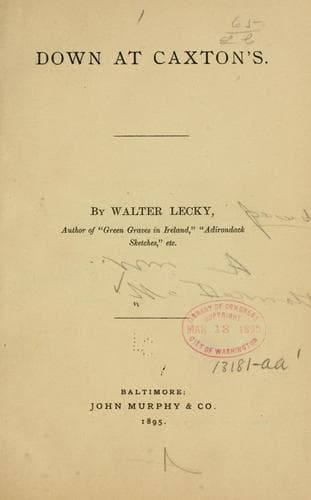
American literature -- 19th century -- History and criticism; American literature -- Catholic authors -- History and criticism
The old wine filled him, and he saw, with eyes
Anoint of Nature, fauns and dryads fair,
Unseen by others; to him maiden-hair
And waxen lilacs and those birds that rise
A-sudden from tall reeds, at slight surprise,
Brought charmed thoughts; and in earth everywhere,
He, like sad Jacques, found a music, rare
As that of Syrinx to old Grecians wise.
A Pagan heart, a Christian soul, had he,
He followed Christ, yet for dead Pan he sighed,
Till earth and heaven met within his breast!
As if Theocritus, in Sicily,
Had come upon the Figure crucified,
And lost his gods in deep, Christ-given rest.
As an essayist, Mr. Egan has touched many subjects, and always in an
entertaining vein. Some of his essays are remarkable for their plain
speaking. He has studied his race in their new surroundings, knows
equally well their virtues and failings. If he can take an honest
delight in the virtues, he is capable of writing with no uncertain
sound on the failings, failings that have been so mercilessly used
by the vulgarly comic school of American playwrights. His essays are
corrective and should find their way into every Irish-American home.
They would tend to correct many abuses and aid in the detection of
those bunions so sacredly kept on the feet of the Irish race—last relic
of the Penal times. A recent essay throws a series of blue lights—the
color so well liked by Carlyle—on our shallow collegiate system. Will
it be read by our Catholic educators? That is a question that time will
answer. If they read it aright they will be apt to change their system
of teaching the classics parrot-like, an empty word translation. They
will transport their pupils from the bare class-room to the sunny skies
of Greece and Rome, and under these skies see the religious dogmas,
the philosophical systems, the fine arts, the entire civilization of
those ancient thought giving nations. “What professor,” says de Guerin,
“reading Virgil and Homer to his pupils, has developed the poetry
of the Iliad or Æneid by the poetry of nature under the Grecian and
Italian skies. Who has dreamt of showing the reciprocal relation of the
poets to the philosophers, the philosophers to the poets, and these in
turn to the artists—Plato to Homer, Homer to Phidias? It is a want of
this that makes the classics so dull to youth, so useless to manhood.”
Public-domain text, read in full here on John Shaqi.
Reviews
Reviews
No reviews yet
Be the first to share your thoughts on this work.
Join the Discussion
Join the discussion
Sign in to leave a comment or review.
Sign InorCreate an account