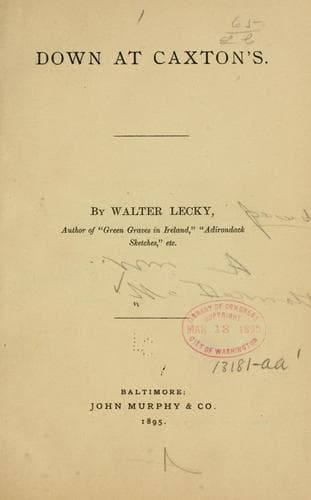
American literature -- 19th century -- History and criticism; American literature -- Catholic authors -- History and criticism
“John B. Tabb, (I quote) was born in Virginia, when or where I know
not. Becoming a Catholic he studied for the priesthood and was
ordained.” Here my data fails me. At present he is the professor of
literature in St. Charles’ College, Maryland. It is something in his
favor, this scanty biographical fare. Where the biography is long,
laudatory, and in rounded periods, it is approached as one would a
snake in the grass, with a kind of fear that in the end you may be
bitten. “May I be skinned alive,” said that master of word-selection
and phrase-juggler, Flaubert, “before I ever turn my private feelings
to literary account.” And the reader, with the stench of recent
keyhole biography in his nostrils, shouts “bravo.” Flaubert’s phrase
might easily have hung on the pen of the retiring worshipper of the
beautiful, “the Roman Catholic priest, who drudges through a daily
round of pedagogical duties in St. Charles’ College.” This quoted
phrase may stand. Pedagogy, at best, is a dull pursuit for a poet. It
is not congenial, and I have held an odd idea that whatever was not
congenial, disguise it as you may, is drudgery. And all this by way of
propping the quoted sentence. The strange thing is that in the midst
of this daily round of drudgery the poet finds time to produce what a
recent critic well calls “verse-gems of thought.” These verse-gems,
if judged by intrinsic evidence, would argue an environment other
than a drudgery habitation. In truth, it is hard to desecrate them by
predicating of them any environment other than a spiritual one.
This brings us to write of Fr. Tabb’s poetry that it is elusive, from
a critical point of view. When you bring your preconceived literary
canons to bear upon it, they are found wanting—too clumsy to test the
delicacy, fineness of touch, and the permeated spiritualism embodied in
the verse-gem. It is well summarized in the saying that “it possesses
to the full a white estate of virginal prayerful art.” One might define
it by negatives, such as the contrary of passion poetry. The point
of view most likely to give the clearest conception would be found
in the sentence: an evocation from within by a highly spiritualized
intelligence. The poet has caught the higher music, the music of a soul
in which dwell order and method. In other words, he has assiduously
cultivated to its fullest development both the spiritual sense and the
moral sense.
It is easy to trace in Fr. Tabb’s poetry the influence of Sidney
Lanier. It has been asserted, and with much truth, that Lanier’s
influence has strangely fascinated the younger school of Southern
poets. Sladen, in his book on Younger American Poets, tells us that
“Lanier differs from the other dead poets included in his book, in that
he was not only a poet but the founder of a school of poetry.” To his
school belongs Fr. Tabb, a school following the founder whose aim is to
depict
Public-domain text, read in full here on John Shaqi.
Reviews
Reviews
No reviews yet
Be the first to share your thoughts on this work.
Join the Discussion
Join the discussion
Sign in to leave a comment or review.
Sign InorCreate an account