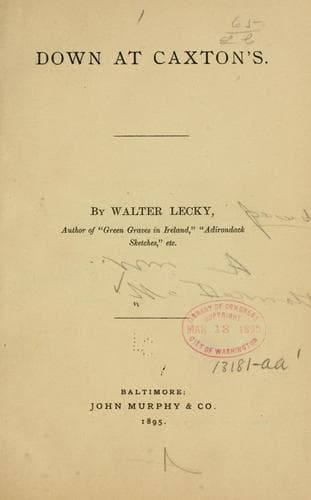
American literature -- 19th century -- History and criticism; American literature -- Catholic authors -- History and criticism
In 1875 he became assistant editor of that staid and stately magazine
the _Atlantic Monthly_, thereby adding to his fame, while it brought
him into intimate relationship with the best current thought of the
time. Few American literary men have not, at some time of their career,
been closely allied with the press. Mr. Lathrop has been no exception.
For two years, from ’77 to ’79, his brilliant pen guided the destinies
of the _Boston Courier_. In 1879 he purchased Hawthorne’s old home,
“The Wayside,” in Concord, Mass., making it his home until his removal
to New York in 1883. His present residence is at New London, Conn.,
where a beautiful home, with its every nook consecrated to books and
paintings, tells of an ideal literary life and companionship. Mr.
Lathrop’s genius is many sided. This is often a sign of strength. Men,
says a recent critic, with a great and vague sense of power in them are
always doubtful whether they have reached the limits of that power, and
naturally incline to test this in the field in which they feel they
have fewer rather than more numerous auguries of success. Into many
fields this brilliant writer has gone, and with success. In some he
has sowed, in others reaped a golden harvest. He was a pioneer in that
movement which rightfully held that an author had something to do with
his brain-work. It seems strange that in this nineteenth century such
a proposition should demand a defender. Sanity, however, is not so
widespread as the optimists tell. The contention of those that denied
copyright was, “Ideas are common property.” So they are, says our
author, but granting this, don’t think you have bagged your game? How
about the form in which those ideas are presented? Is not the author’s
own work, wrought out with toil, sweat and privation—is not the labor
bestowed upon that form as worthy of proper wage as the manual skill
devoted to the making of a jumping jack? Yet no one has denied that
jumping-jacks must be paid for. This was sound reasoning and would have
had immediate effect, had Congress possessed a ha’penny worth of logic.
As it was, years were wasted agitating for a self-evident right, men’s
energies spent, and at length a half-loaf reluctantly given.
Public-domain text, read in full here on John Shaqi.
Reviews
Reviews
No reviews yet
Be the first to share your thoughts on this work.
Join the Discussion
Join the discussion
Sign in to leave a comment or review.
Sign InorCreate an account