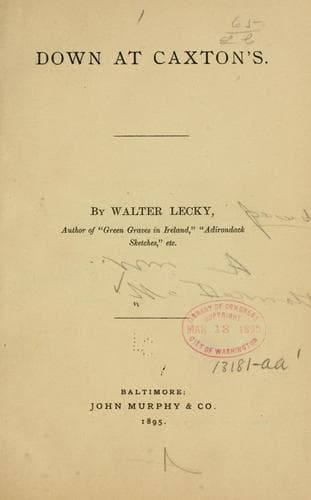
American literature -- 19th century -- History and criticism; American literature -- Catholic authors -- History and criticism
Patrick Francis Mullaney, better known as Brother Azarias, was born
in Killenaule County, Tipperary, Ireland, June 29th, 1847. Like the
majority of eminent men that his country has given birth to, he came
of its noble peasantry. The old tale was here enacted. The parents
left the land of their birth in search of a home in our better land.
This found, Azarias joined them. At the age of fifteen he joined the
Christian Brothers. That great Order gave free scope to his fine
abilities. In 1866 he was chosen professor of mathematics and English
literature at Rock Hill College, Maryland. He continued in this
position for ten years. At the expiration of his professorship he
travelled a year through Europe, collecting materials and writing his
“Development of Old English Thought.” On his return he became president
of Rock Hill College, holding that position until recalled to Paris by
his Superior in 1866. After an absence of three years Brother Azarias
returned to the States as professor of English literature at the De
La Salle Institute, New York. This is not only an important position,
but it gives leisure, and that ready access to the great libraries, so
prized by literary men.
WOMEN.
KATHERINE ELEANOR CONWAY.
“Next room to that of Roche’s,” said the dear O’Reilly, showing me his
nest of poets, “is a gentle poetess.”
The door was wide open. It is a question with my mind if the room ever
knew a door. Be this as it may, there sat, with her chair close drawn
to her desk, a frail, delicate-looking woman. The ordinary eye might
see nothing in a face that was winsome, if not handsome; yet, let the
dainty mouth curve in speech, and at once a subtle attraction, lit up
by lustrous eyes, permeated the face. One characteristic that made
itself felt, in the most sparse conversation with this woman, was her
humility, a rare virtue among American literary women. I have known
not a few among that irritable class who, no sooner had they sipped the
most meagre draught of fame, than they became intoxicated with their
own importance, and for the balance of life wooed that meretricious
goddess, Notoriety. In fiery prose and tuneful song they told of the
dire misfortunes that had been heaped upon their sex by that obstinate
vulgar biped, man. Their literature—for that is the name given to
the crudest offspring of the press in these days—is noisy, and, says
a witty writer, a noisy author is as bad as a barrel organ,—a quiet
one is as refreshing as a long pause in a foolish sermon. Clergymen,
who have listened to a brother divine on grace, will be the first to
see the point. Our authoress—(a female filled with the vanity that
troubled Solomon says I should write female author)—is a quiet and
unobtrusive writer. Of the tricks that catch and the ways that are
crooked in literature, she knows nothing, and what is better, no amount
of tawdry fame could induce her to swerve a jot from the hard stony
Public-domain text, read in full here on John Shaqi.
Reviews
Reviews
No reviews yet
Be the first to share your thoughts on this work.
Join the Discussion
Join the discussion
Sign in to leave a comment or review.
Sign InorCreate an account