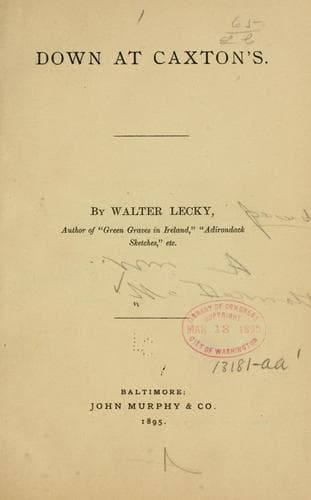
American literature -- 19th century -- History and criticism; American literature -- Catholic authors -- History and criticism
“Dream nobly and plan loftily” has been the guiding spirit of this
volume. It is a book of religious verse in the true sense, not in the
general acceptance of modern religious verse, which is generally dull
twaddle, egotism, mawkishness, blind gropings and haunting fears. The
gentle spirit of Christ breathes through it, making an atmosphere of
peace and repose. There is no bigotry to jar, no narrowness to chafe
us, but the broad upland of Christian charity and truth. Nor has our
author forgotten that even truth if cast in awkward mould may be passed
over. To her poems she has given a dainty setting without sacrificing
a jot of their strength. After reading such a book a judicious bit of
Miss Conway’s prose comes to my mind. “And as that Catholic light, the
only true vision, brightens about us, we realize more and more that
literary genius, take it all and all, has done more to attract men
to good than to seduce men to evil; that the best literature is also
the most fascinating, and even by its very abundance is more than a
match for the bad; that time is its best ally; that it is hard, if
not impossible, to corrupt the once formed pure literary taste; and,
finally, that as makers of literature or critics or disseminators
of it, it is our duty to believe in the best, hope in the best, and
steadfastly appeal to the best in human nature; for we needs must love
the highest when we see it.”
Katherine Eleanor Conway was born of Irish parents, in Rochester, on
the 6th of Sept., 1853. Her early studies were made in the convent
schools of her native city. From an early age she had whisperings of
the muse. These whisperings at the age of fifteen convinced her that
her true sphere of action was literature. In 1875 she commenced the
publication of a modest little Catholic monthly, contributing poems and
moral tales, under the _nom-de-plume_ of “Mercedes,” to other Catholic
journals, in the spare hours left from editing her little venture and
teaching in the convent. In 1878 she became attached to the Buffalo
_Union and Times_. To this journal she contributed the most of the
poems to be found in her maiden volume,—“On the Sunrise Slope,”—a
volume whose rich promise has been amply fulfilled in the “Dream of
Lilies.” Her health failing, she sought a needful rest in Boston. Her
fame had preceded her, and the gifted editor of the _Pilot_, ever on
the lookout for a hopeful literary aspirant of his race, held out a
willing hand to the shy stranger. “Come to us,” he said, in a voice
that knew no guile, “and help us in the good fight.” That fight—the
crowning glory of O’Reilly’s noble life—was to gain an adequate
position for his race and religion from the puritanism of New England.
How that race and religion were held before his coming, may be best
told in the language of Miss Conway, taken from a heart-sketch of her
dead master and minstrel:—
Public-domain text, read in full here on John Shaqi.
Reviews
Reviews
No reviews yet
Be the first to share your thoughts on this work.
Join the Discussion
Join the discussion
Sign in to leave a comment or review.
Sign InorCreate an account