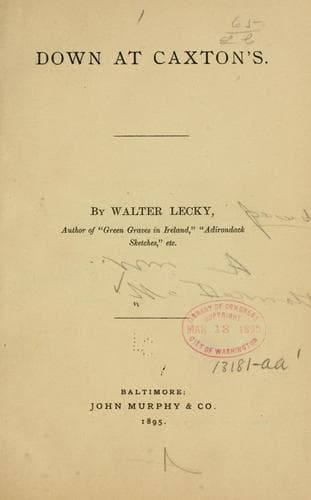
American literature -- 19th century -- History and criticism; American literature -- Catholic authors -- History and criticism
It was owing to his kindness that I found myself one blustery, raw day,
ringing the door-bell of an ordinary well to-do brick house. Houses
now and then carry on their fronts an inkling of their occupants. A
door was opened, my card handed to a feminine hand; the aperture was
not as yet wide enough to catch a glimpse of the face. The card was a
power. “Come in,” said a woman’s voice, and the door was wide open. I
followed the guide, and was soon in a plain, well furnished room, in
presence of a motherly-looking woman. She was knitting; at least that
is part of my memory’s picture. Near her hung a mocking-bird, whose
notes now and then were peculiarly sad. Despite the graceful lines of
the Cavalier Lovelace, iron bars do a prison make for bird and man. And
the songs sung behind these bars are but bits of the crushed-out life.
I was welcomed, and during busy years have held the remembrance of
that visit with its hour of desultory chat and a mocking-bird’s broken
song. The motherly-looking woman, with her strong Celtic face freshly
furrowed by sorrow in the loss of beloved children, was a charming
talker and a good listener, things rarely found in your gentle or fiery
poetess. She had just published, under the initials M. A. B., a volume
of children’s verse, and, as is natural with an author who had finished
a piece of work, was full of it. The pretense of some authors that they
are bored to speak of their own books is a sly suggestion to praise
them for their humility. Mrs. Blake—for that is the motherly-looking
woman’s name—spoke of her work without any hiccoughing gush or false
modesty. Her eyes lit up, and the observer read in them honesty. She
was deeply interested, as all thinking women must be, in the solution
of the social problems that have arisen in our times, and will not be
downed at the biddance of capitalist or demagogue. With her clear-cut
intellect she was able to grasp a salient point, purposely hidden by
the swarm of curists with their panacea remedies, that these problems
must be solved in the light of religion. Man must return to Christ,
not the “cautious, statistical Christ” paraded in the social show, not
“The meteor blaze
That soon must fail, and leave the wanderer blind,
More dark and helpless far, than if it ne’er had shined,”
Public-domain text, read in full here on John Shaqi.
Reviews
Reviews
No reviews yet
Be the first to share your thoughts on this work.
Join the Discussion
Join the discussion
Sign in to leave a comment or review.
Sign InorCreate an account