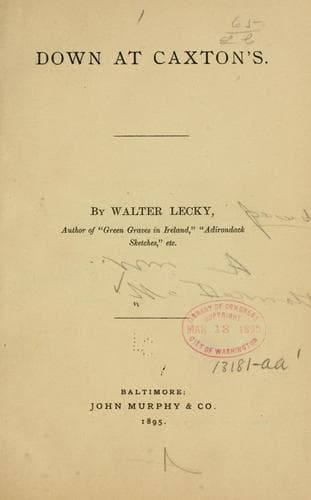
American literature -- 19th century -- History and criticism; American literature -- Catholic authors -- History and criticism
We are told, with some show of truth, that this age shall be noted in
history as one given to the study of social problems. The contemporary
literature of a country is a good index to what people are thinking
about. Magazines are, as a rule, for their time, and deal with the
forces upward in men’s minds. The most cursory glance at their contents
will show the predominance of the Social Problem treated from some
phase or other. The best minds are engaged as partisans. Social
science may be said to be the order of the day. It has crushed poetry
to the skirts of advertising, romance is its happy basking ground.
The drama has made it its own. There are some, fogies of course, so
says your sapient scientist, who believe that the social science so
spasmodically treated in current literature is but a passing fad, and
that poetry shall be restored to her old quarters, romance amuse as of
old, and the drama be winnowed of rant, scenic sensation, and bestial
morality. These dreams may be vain, but then even fogies have their
hopes. A branch of this science—the tree is overshadowing—treats of the
literature and the masses. Anything about the masses interests me.
When I read the other day, “Literature and the Masses; a Social Study,”
among the contents of a _fin de siècle_ magazine, I would have pawned
my wearing apparel rather than go home without it. Its reading was
painful, as all reading must be where the author knows less about his
subject than the ordinary reader. Later, another article fell in my
way, dealing with the same subject. Its author had more material, but
his use of it was clumsy. It was while reading this article, that I
noted the utter stupidity with which things Catholic are treated by the
ordinary literary purveyor. These ephemeral pen-wielders seem to hold
the most fantastic notions of the Church. What Azarias says of Emerson
is true of them: “They seek truth in every religious and philosophical
system outside of the teachings of the Catholic Church.” They will not
drink from Rome. To correct all this author’s errors is not my plan. In
this paper I restrict myself to a part of the same subject, Literature
and Our Catholic Poor. I prefer an independent study to patchwork. It
is the usual thing in such studies to present credentials. I present
mine. Five years’ life in the tenement districts of New York and other
great cities of the Union, in full contact, from the peculiarity of my
position, with the poor. During these years I was led to make a study
of their reading. This study, to be intelligible, must be prefaced by
a few hints on their life and environment. It is useless to deny the
often-repeated assertion that their lot in the great cities is hard
and crushing. It is a continual struggle for nominal existence. The
children commence work at a premature age. Their education is meagre
and broken. Marriage is entered in early life, without the slightest
provision. To these marriages there is little selection. The girls have
Public-domain text, read in full here on John Shaqi.
Reviews
Reviews
No reviews yet
Be the first to share your thoughts on this work.
Elsewhere in the archive
Join the Discussion
Join the discussion
Sign in to leave a comment or review.
Sign InorCreate an account