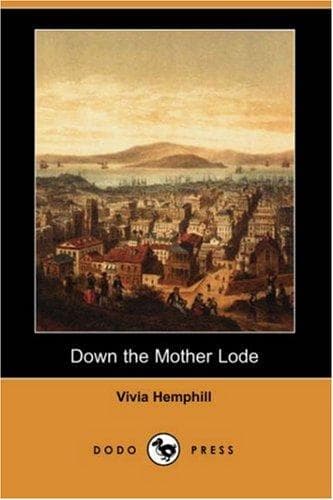
California -- Gold discoveries -- Fiction; Frontier and pioneer life -- California -- Fiction; Short stories, American
“On that broad stage of empire won,
Whose footlights were the setting sun;
Whose flats a distant background rose
In trackless peaks of endless snows;
Here genius bows, and talent waits
To copy that but One creates.”
--Bret Harte.
Now-a-days when you want to go from San Francisco to the Sierra Nevada
country you step into your perfectly good Packard (or whatever it
is--all the way down to a motorcycle side car), and you ferry across
the bay and the straits, and if the motor-cop isn't around, you come
shooting up the highway forty miles an hour, and at the end of a
glorious five-hour run you are there.
In the early fifties--when there was less to see, too--you took more
time to it. You came to Sacramento on the river boat. Then if you
were rich, you bought a horse or a mule and rode for the rest of your
journey. If you were poor, or thrifty perhaps, you walked, or tried to
get a ride on one of the ox-freight teams which plied their way across
Haggin Grant to Auburn and Dutch Flat, or to Folsom and Coloma.
Later a railway was built as far as Auburn station, then situated at a
point three miles east of Loomis which was at that time called Pino.
Nothing remains of Auburn station. But the road bed of the old railway
is still to be found in certain wooded tracts which have not given way
to the fruit ranches; and the highway from Fair Oaks into Folsom follows
the old cuts and grades for several miles.
In the days preceding and immediately following the discovery of gold
in California, building was very difficult. Every stick of lumber in my
grandfather's house came by ship “around the Horn,” and the fruit trees
grape vines, flowers, even bees, for his lovely garden: were all sent
from Europe.
In the smaller settlements there was seldom more than one large building
which could be used for social purposes, and this was often the card
room or bar room in connection with the hotel of the town.
So here is the tale that was told of one Sunday in Stinson's bar room,
in the late '50s at Auburn Station:
They tried to give a ball once a year at Stinson's. Persons came to it
from 30 miles about, particularly if they were women, and every woman
divided each dance among four men. When a man invited a lady to come to
a dance, in many instances he insisted upon the privilege of buying her
a silken gown and slippers to wear, and this was not considered unusual,
nor was she in any way obligated to him for it. There were so few
“ladies” that they were treated as little short of divinities.
This Saturday night there had been no dance, and the men at Gentleman
Jack's table at Stinson's had played “three-card monte” on through the
dawn and the sunrise, and into broad daylight. The door was pushed open,
letting in a rush of cool, sweet air which guttered the candles set
in old bottles, and drove the heavy fog of tobacco smoke toward the
blackened ceiling. A voice boomed forth:
Public-domain text, read in full here on John Shaqi.
Reviews
Reviews
No reviews yet
Be the first to share your thoughts on this work.
Join the Discussion
Join the discussion
Sign in to leave a comment or review.
Sign InorCreate an account